|
|
And by the way... In May '98 Exploration of the Magnetosphere was picked as one of
"Ten Cool Sites" by the Exploratorium in San Francisco. It is a site worth visiting and lists many other interesting links.
"Exploration" was also recommended by "Web Watch" in the January 1999 issue of Physics Today (page 63).
#######################
#1. The Magnetosphere
|
In our everyday environment, magnetic forces are of no importance and a sensitive instrument, the compass needle, is needed to detect them. That is because we, the materials we encounter in everyday life, even the oxygen and nitrogen which we breathe, are all electrically neutral. The atoms of oxygen, for instance, contain electrons with negative electric charges and protons which are positive, but the two charges balance each other andthe electric and magnetic forces cancel. Magnetic forces have almost no effect on neutral atoms. |
| However, 60 miles (100 km) or more above the surface of the Earth, the natural environment is quite different. The fringes of the atmosphere at these heights are strongly heated by the Sun's x-rays and ultra-violet light (and by other causes as well), causing negative electrons to be torn off atoms and leaving the remainder of the atoms as positively charged "ions". These electrified fragments react strongly to the magnetic forces and can be steered and trapped by them. With a suitable input of energy, such fragments can also be accelerated to high speeds, can give rise to electic currents and emit a variety of radio-type waves. |
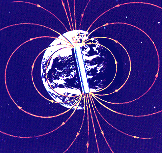
| It can be shown that such free electrons and ions will be guided by the magnetic field lines (or "lines of force") which rise from near the southern (magnetic) pole and enter the Earth again near the northern pole. Electrons and ions tend to remain attached to field lines like beads on wires, though unlike beads they also slowly migrate ("drift") to neighboring "wires." |
|
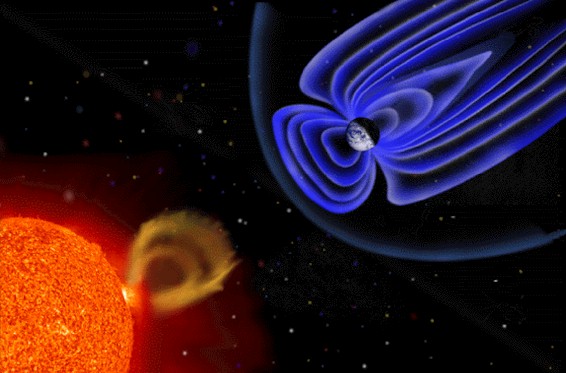
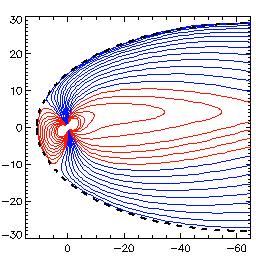
It follows that the structure of field lines near Earth determines much of the motion and behavior of the free electrons and ions found there. Satellites observing magnetic forces in space have found (figure on right) that in most directions, those lines do not go indefinitely far but are confined inside a cavity, the magnetosphere of the Earth. The space outside it is dominated by the Sun, and by the fast "solar wind" of free ions and electrons emitted by the Sun.
| 
|
Next Stop: #1H. History
#######################
|
In the 1830s a world-wide network of magnetic observatories was set up and it was then realized that disturbances of the compass needle, which were occasionally noticed, occured on a world wide pattern. They seemed to come from outside the Earth, and Alexander von Humboldt named them magnetic storms
|
|
There followed more than a century of attempts to study and understand these elusive phenomena. Only after 1958, when the first scientific spacecraft were launched and when Explorers 1 and 3 discovered the radiation belt, did scientists fully appreciate the complexity of electric and magnetic phenomena that occur in the Earth's magnetic environment. In 1959 Thomas Gold of Cornell University proposed to name that environment "magnetosphere", and this name is still used.
Further reading:
|
Next Stop: #2. Magnetic Fields
#######################
|
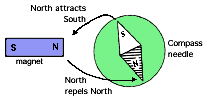
Either pole can also attract iron objects such as pins and paper clips. That is because under the influence of a nearby magnet, each pin or paper clip becomes itself a temporary magnet, with its poles arranged in a way appropriate to magnetic attraction.
But this property of iron is a very special type Out in space there is no magnetic iron, yet magnetism is widespread. For instance, sunspots consist of glowing hot gas, yet they are all intensely magnetic. The Earth's own magnetic powers arise deep in its interior, and temperatures there are too high for iron magnets, which lose all their power when heated to a red glow. What goes on in those magnetized regions? It is all related to electricity.
|
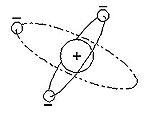
| Matter consists of electrically charged particles: each atom consists of light, negative electrons swarming around a positive nucleus. Objects with extra electrons are negatively (-) charged, while those missing some electrons are positively (+) charged. Such charging with "static electricity" may happen (sometimes unintentionally!) when objects are brushed with cloth or fur on a dry day. Experiments in the 1700s have shown that (+) repels (+), (- ) repels (-), while (+) and (-) attract each other.
|
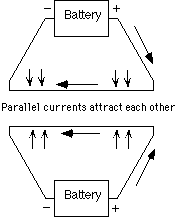
| --Two parallel currents in the same direction attract each other. --Two parallel currents in opposite directions repel each other.
|
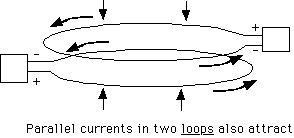
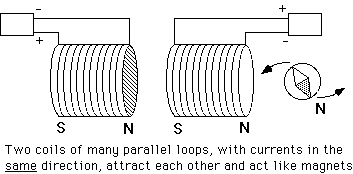
| --Two circular currents in the same direction attract each other. --Two circular currents in opposite directions repel each other.
|
Next Stop: #2H. History
###########################
|
It was believed that the inside of the Earth was magnetized in the same fashion, and scientists were greatly puzzled when they found that the direction of the compass needle at any place slowly shifted, decade by decade, suggesting a slow variation of the Earth's magnetic field. How can an iron magnet produce such changes? Edmond Halley (of comet fame) ingeniously proposed that the Earth contained a number of spherical shells, one inside the other, each magnetized differently, each slowly rotating in relation to the others.
|  Edmond Halley Edmond Halley
|
 Hans Christian Oersted Hans Christian Oersted
| Hans Christian Oersted was a professor of science at Copenhagen University. In 1820 he arranged in his home a science demonstration to friends and students. He planned to demonstrate the heating of a wire by an electric current, and also to carry out demonstrations of magnetism, for which he provided a compass needle mounted on a wooden stand.
|
|
While performing his electric demonstration, Oersted noted to his surprise that every time the electric current was switched on, the compass needle moved. He kept quiet and finished the demonstrations, but in the months that followed worked hard trying to make sense out of the new phenomenon.
| 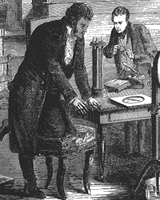 Oersted's Experiment Oersted's Experiment
|
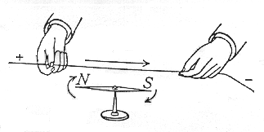 What Oersted saw... What Oersted saw...
| But he couldn't! The needle was neither attracted to the wire nor repelled from it. Instead, it tended to stand at right angles (see drawing below). In the end he published his findings (in Latin!) without any explanation.
|
Andre-Marie Ampere in France felt that if a current in a wire exerted a magnetic force on a compass needle, two such wires also should interact magnetically. In a series of ingenious experiments he showed that this interaction was simple and fundamental--parallel (straight) currents attract, anti-parallel currents repel.
The force between two long straight parallel currents was inversely proportional to the distance between them and proportional to the intensity of the current flowing in each.
(it gets further complicated if the currents flow in directions inclined to each other by some angle). To find then the force between wires of complicated shape that carry electrical currents, all these little bitty contributions to the force must be added up. For two straight wires, the final result is as above--a force inversely proportional to R, not to R2]
|
| There thus existed two kinds of forces associated with electricity--electric and magnetic. In 1864 James Clerk Maxwell demonstrated a subtle connection between the two types of force, unexpectedly involving the velocity of light. From this connection sprang the idea that light was an electric phenomenon, the discovery of radio waves, the theory of relativity and a great deal of present-day physics. | 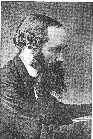 Maxwell Maxwell
|
Repeat Oersted's Experiment !You will need:
|
Futher reading:--look up in an encyclopaedia "Halley, Edmond", "Oersted, Hans Christian", "Ampere, Andre-Marie" and "Maxwell, James Clerk."--"From Falling Bodies to Radio Waves" by Emilio Segre, W.H. Freeman and Co., 1984, gives a very good account of the history of electricity and magnetism (and of physics up to 1895). Segre, who won the Nobel prize in physics, wrote in a clear style with many insights and anecdotes about the discoveries which laid the foundations of physics. --"Oersted and the Discovery of Electromagnetism" by Bern Dibner (Blaisdell Publ. Co., 1962), a slim book with details about Oersted and his time. --"Andre-Marie Ampere" by L.Pearce Williams, Scientific American January 1989, p. 90. --"Edmond Halley, Geophysicist" by Michael E. Evans, Physics Today, February 1988, p. 41-45.
|
Next Stop: #3. The Polar Aurora
#######################
#3. The Polar Aurora
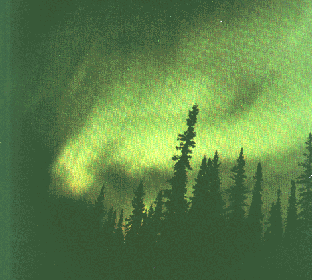 Click here for a full size version of this image.
|
|
|
|
| Location
|
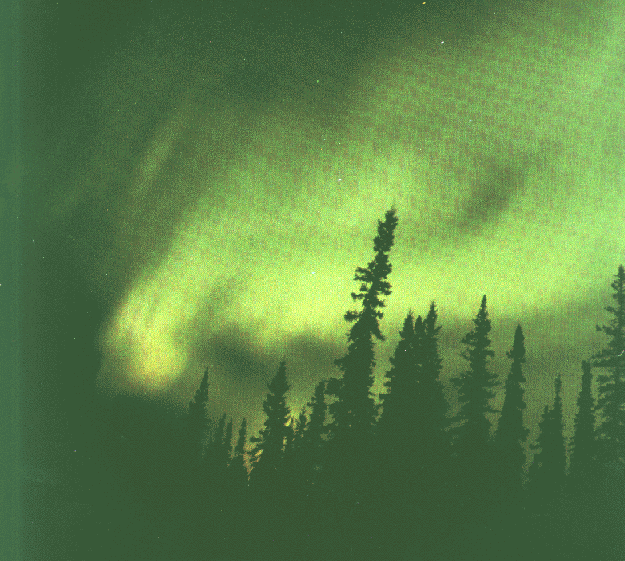
The magnetic connection is also demonstrated by the fact that the rays of the aurora lie along magnetic field lines, and that the Earth's magnetic field observed beneath a bright and active aurora tends to be disturbed.
|
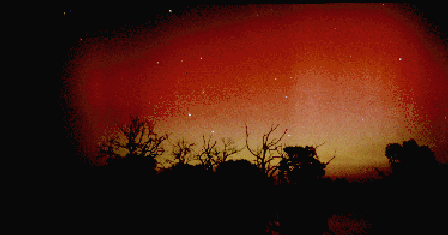
ColorThe green light of the aurora has a precisely defined color in the spectrum ("narrow spectral line"). Such precise colors are usually the signatures of the atoms which emit them: for instance, street lights (depending on the metal vapor they contain) usually emit either the yellow-orange light of sodium or the bluish light of mercury.The green light of the aurora puzzled scientists for many years, since it fit no known element. It turned out to be produced by oxygen atoms, but under conditions that in our atmosphere only exist in the very rarefied upper levels. A red aurora, occasionally seen, arises at even greater heights and is also produced by electrons hitting oxygen.
|
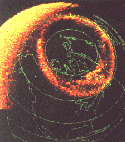
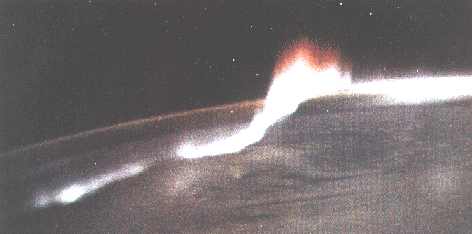
Observing the aurora from spaceSatellites nowadays observe the aurora from above, using cameras more sensitive than the human eye. On dark parts of the polar cap they can "see" aurora at most times, forming a large "auroral oval" which extends around the magnetic pole.
|
 |
Further reading:--"Majestic Lights, The Aurora in Science, History and the Arts" by Robert H. Eather, American Geophysical Union, 1980.--"The Aurora" by Candace Savage, Sierra Club, 1995.
|
Next Stop: #3H. History of Early Auroral Studies
#######################
|
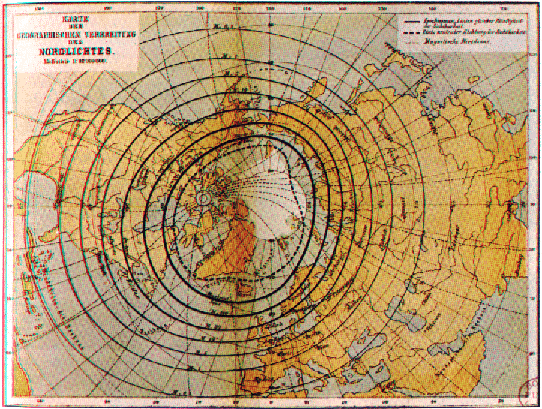
The term "aurora borealis" was used in 1621 by the French scientist and philosopher Pierre Gassendi, but George Siscoe has given reasons to believe it was introduced by Galileo Galilei in 1619 (p. 51 in "Majestic Lights", cited below). Elias Loomis of Yale University compiled, in 1860, a map marking how many times in an average year were auroras observed in various locations (click here to see his map). A more accurate map was compiled in 1881 by Hermann Fritz (1830-1883) (click here to see Fritz'es map).
| 
|
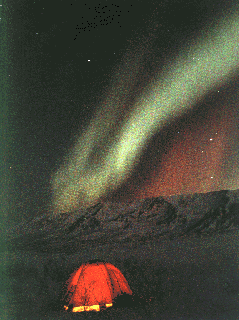
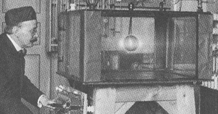 Birkeland and his terrella.
| It was long suspected that the aurora was caused by electrons arriving from the outside and hitting the high atmosphere. The Norwegian physicist Kristian Birkeland (1867-1917), for instance, placed a magnetized sphere, a "terrella" representing the Earth, inside a vacuum chamber, and aimed a beam of electrons towards it. He was gratified to see that the electrons were steered by the magnetic field to the vicinity of the terrella's magnetic poles.
|
|
However, it was only in 1954 that auroral electrons were actually observed, by detectors aboard a rocket launched into the aurora by Meredith, Gottlieb and Van Allen, of Van Allen's team at the University of Iowa. Carl McIlwain, another member of that team, used a 1959 rocket experiment to identify the particles as electrons of an average energy corresponding to acceleration by 6000 volts (see high energy particles). Nowadays scientific satellites regularly cross streams of auroral electrons and measure their properties, and aurora is also observed from the ground with video cameras and special radars.
Futher reading:
Next Stop: #4. Electrons
|
|
Below is map of the frequency with which aurora is seen in various polar regions, produced in 1860 by Elias Loomis (1811-1889), professor of natural philosophy at Yale. The central band has at least "80 auroras annually".
| 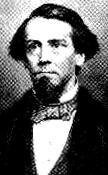 Elias Loomis
|
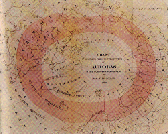
| One might expect the center of the pattern to be at the magnetic pole, but it is not: the magnetic pole is in northern Canada, while the center of the pattern is near the northwestern end of Greenland. The reason is that the Earth's field is not exactly like that of a bar magnet, but contains additional irregularities, more complex and effective mainly near the surface, not far out in space.
|
#######################
|
Shown here is a map of the frequency with which auroras are seen, produced in 1881 by the German scientist Hermann Fritz (1830-1883). The line of greatest frequency lists 100 auroras per year, while in the center of the pattern auroras are much less frequent.
| 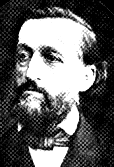 Hermann Fritz Hermann Fritz
|
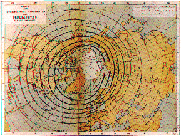 Click here for a full size version (232 K) of this image.
| If the Earth's field resembled that of a simple bar magnet ("dipole"), its magnetic pole would be near the northwestern tip of Greenland, in the middle of the pattern. However, the field contains additional complex parts, whose effect does not extend as far into space, and these shift the pole actually observed on the ground to northern Canada, to the location shown on the map.
|
#######################
 Gilbert's terrella
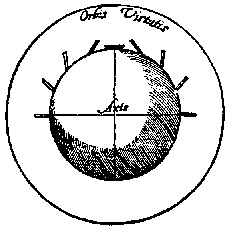
| "Terrella" is Latin for "little Earth," the name given by William Gilbert to a magnetized sphere with which he demonstrated to Queen Elizabeth I his theory of the Earth's magnetism. By moving a small compass around the terrella and showing that it always pointed north-south, Gilbert argued that the same thing, on a vastly larger scale, was happening on Earth, and was the only reason why a compass pointed north-south. Later scientists such as Birkeland used the name "terrella" for magnetized spheres used inside vacuum chambers, together with electron beams, to study the motion of fast charged particles near the Earth. A sophisticated terrella experiment in a vacuum chamber is currently operated by Dr. Hafez u-Rahman at the University of California at Riverside.
|
#######################
|
Matter consists of atoms, and atoms consist of electrically charged components--lightweight negative electrons, and positive nuclei.
How do we know?One clue comes from the "Edison effect," discovered by Thomas Alva Edison. Imagine a glass bulb from which air has been pumped, until hardly any of it remains. In one end we embed a metal coil of wire (like that of a flashlight bulb) in the other a metal plate, as drawn. Connect now a battery between the coil and the plate, so that the former is negative and the latter is positive.
|
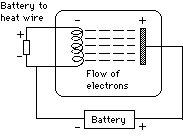
| No current will flow in this circuit: some atoms or molecules may be left inside the bulb, but they are electrically neutral, and can carry no electric current. Air is an excellent insulator: electric companies can string power lines in the open air and never have to worry about currents dribbling out on their way from the power station to consumers.
|
|
Now connect a second battery to the end of the coil, so that a current flows through the coil and heats it up. As the wire begins to glow, a current begins to flow, because now negatively charged particles are emitted from the hot wire, are attracted to the positive charge on the plate and by doing so, complete the electrical circuit. Suppose the connections of the first battery are reversed, so that now the coil is positive and the plate is negative. Then no current flows, showing that the hot wire releases only negative particles, not positive ones. These particles were named electrons In laboratory experiments these particles were directed by electrically charged structures (similar to the "electron guns" inside TV picture tubes) to form beams. Those beams were then bent by magnets and by electrified plates, and their behavior was studied. From such experiments and others the mass of the emitted particles, which became known as "electrons", could be determined. It turned out that they were rather lightweight. The simplest atom, that of hydrogen, contains a central positive particle, a proton, and a single electron, and the proton is nearly 2000 times heavier. |
Next Stop: #4H. History of the Electron
#######################
|
The experiment with a pumped-out glass bulb, in which an electric circuit is completed by electrons emitted from a hot wire, is credited to the US inventor Thomas Alva Edison (1847-1931), who patented it in 1883. The phenomenon is known as the "Edison effect" and many electronic devices use it nowadays.
|
|
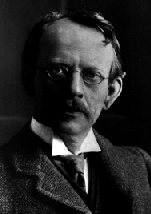
Experiments with beams of negative particles were performed in Britain by Joseph John ("J.J.") Thomson, and led to his conclusion in 1897 that they consisted of lightweight particles with a negative electric charge, nowadays known as electrons. Thomson was awarded the 1906 Nobel Prize. The word "elektron" in Greek means amber, the yellow fossilized resin of evergreen trees, a "natural plastic material" already known to the ancient Greeks. It was known that when amber was rubbed with dry cloth--producing what now one would call static electricity--it could attract light objects, such as bits of paper.
|
|
|
William Gilbert, a physician who lived in London at the time of Queen Elizabeth I and Shakespeare, studied magnetic phenomena and demonstrated that the Earth itself was a huge magnet, by means of his "terrella" experiment. But he also studied the attraction produced when materials such as amber were rubbed, and named it the "electric" attraction. From that came the word "electricity" and all others derived from it. During the 1800s it became evident that electric charge had a natural unit, which could not be subdivided any further, and in 1891 Johnstone Stoney proposed to name it "electron." When J.J. Thomson discovered the light particle which carried that charge, the name "electron" was applied to it. The many applications of electrons moving in a near-vacuum or inside semiconductors were later dubbed "electronics."
Further reading:
|
Next Stop: #5. Magnetic Field Lines
#######################
|
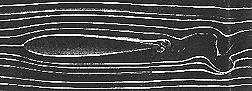
When researchers map the three-dimensional flow of a river around a bridge pier, or of wind around the wing of an airplane (picture below), they use streamlines, lines that trace the flow of particles of water or air.
| 
|
|
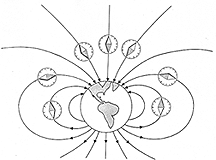
Field lines converge where the magnetic force is strong, and spread out where it is weak. For instance, in a compact bar magnet or "dipole," field lines spread out from one pole and converge towards the other, and of course, the magnetic force is strongest near the poles where they come together. The behavior of field lines in the Earth's magnetic field is very similar.
| 
|
|
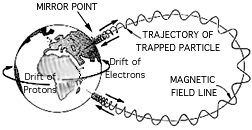
| Field lines were introduced by Michael Faraday (see history), who named them "lines of force." For many years they were viewed as merely a way to visualize magnetic fields, and electrical engineers usually preferred other ways, mathematically more convenient. Not so in space, however, where magnetic field lines are fundamental to the way free electrons and ions move. These electrically charged particles tend to become attached to the field lines on which they reside, spiralling around them while sliding along them, like beads on a wire (drawing below).
|
|
Because of this attachment, the behavior of electrified gas ("plasma") in space, a gas of free ions and electrons, is dictated by the structure of field lines: electric currents, for instance, find it easiest to flow along such lines. Indeed, the role of field lines in a plasma resembles that of grain in wood: just as the grain is the "easy" direction along which wood splits most readily, so the direction of field lines is the one along which particles, electric currents, heat and certain types of waves prefer to flow.
| 
|
|
Exploring further
A small bar magnet, on gimbals that allow it to point in any direction in space, can be procured from its manufacturer, Cochranes of Oxford, Ltd., Leafield, Oxford OX8 5NT, England. Two types are available, Mark 1 with jewelled bearings for $36.60, Mark 2 with simple bearings for $12.65. For details see their web site: |
Next Stop: #5H. Field Lines--History
#######################
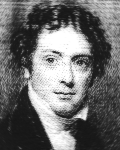
The son of a blacksmith, Faraday was apprenticed to a bookbinder and often read books brought in for rebinding. Luckily for science, one of those was the volume of the Encyclopaedia Britannica with the article about "electricity." His interest drove him to popular lectures given by Humphrey Davy, Britain's leading chemist ("he lived in the odium/of having discovered sodium"), and when Davy needed an assistant, Faraday landed the job on the strength of notes he had kept of Davy's lectures. There followed a lifelong career in physics and chemistry, with many notable achievements.
|
|
|
|
Following Maxwell, we nowadays call a space modified by the presence of magnetic field lines a "magnetic field": if a bar magnet is placed there, it will experience magnetic forces, but the field exists even when no magnet is present. Similarly, an "electric field" is the space in which electric forces may be sensed--for instance between metal objects charged (+) and (-) by a battery, as in the drawing accompanying the discussion of the electron. Maxwell also showed (perhaps his greatest achievement) that an "electromagnetic wave" was possible, a rapid interplay of electric and magnetic fields spreading with the velocity of light. Maxwell correctly guessed that light was in fact such a wave, that it was basically an electromagnetic phenomenon, and with this his equations paved the way to a much deeper understanding of optics, the science of light. Maxwell's younger colleague, the German Heinrich Hertz, calculated in 1886 that waves of this type would be broadcast by a rapidly alternating current in a short antenna. He then obtained such a current from an electric spark (which does produce a fast back-and-forth oscillation of electric charge) and demonstrated his "Hertzian waves" experimentally. His work was continued by scientists all over the world--e.g. by the Russian Alexander Stepanovich Popov who around 1895 detected radio waves from lightning (a natural spark!), and by the Italian Gugliemo Marconi who, at about the same time, developed the first commercial radio applications. The waves that carry radio and television, microwaves, infra-red, visible light, ultra-violet, x-rays and gamma rays are all variations of the same basic process envisioned by Maxwell, namely, they all belong to the family of electromagnetic waves. It may seem strange that empty space can be modified by electric and magnetic influences, as the field concept proposes. Yet it allows one to understand light and radio waves, and also to retain the conservation of energy. When a transmitter on a spacecraft broadcasts a radio signal, most of that signal spreads out into space and never reaches Earth. Is its energy lost? No, it now resides in an ever-spreading electromagnetic field, associated with the radio wave.
|
Next Stop: #6. Electromagnetic Waves
#######################
#6. Electromagnetic WavesPerhaps the greatest theoretical achievement of physics in the 19th century was the discovery of electromagnetic waves. The first hint was an unexpected connection between electric phenomena and the velocity of light.Electric forces in nature come in two kinds. First, there is the electric attraction or repulsion between (+) and (-) electric charges. It is possible to use this to define a unit of electric charge, as the charge which repels a similar charge at a distance of, say, 1 meter, with a force of unit strength (actual formulas make this precise). But second, there is also the attraction and repulsion between parallel electric currents. One could then define the unit of current, as the current which, when flowing in a straight wire, attracts a similar current in a parallel wire 1 meter away with a force of unit strength, for every meter of the wires' length. But electric current and charge are related! We could have just as well based the unit of current on the unit of charge--say, as the current in which one unit of charge passes each second through any cross section of the wire. This second definition turns out to be quite different, and if meters and seconds are used in all definitions, the ratio of the two units of current turns out to be the speed of light, 300,000,000 meters per second. In Faraday's time the speed of light was known, although not as accurately as it is today. It was first derived around 1676 by Ole (Olaus) Roemer, a Danish astronomer working in Paris. Roemer tried to predict eclipses of Jupiter's moon Io (mentioned later here in an altogether different connection) and he found a difference between actual and predicted eclipse times, which grew and then decreased again as the Earth circled the Sun. He correctly guessed the reason, namely, as the Earth moved in its orbit, its distance to Jupiter also went up and down, and light needed extra time to cover the extra distance. But what was the meaning of the link between electricity and light? Remember the idea of Faraday which evolved into the "magnetic field" concept--that space in which magnetic forces may be observed is somehow changed? Faraday also showed that a magnetic field which varied in time--like the one produced by an alternating current (AC)--could drive electric currents, if (say) copper wires were placed in it in the appropriate way. That was "magnetic induction," the phenomenon on which electric transformers are based. So, magnetic fields could produce electric currents, and we already know that electric currents produce magnetic fields. Would it perhaps be possible for space to support a wave motion alternating between the two? Sort of:
|
|
|
|
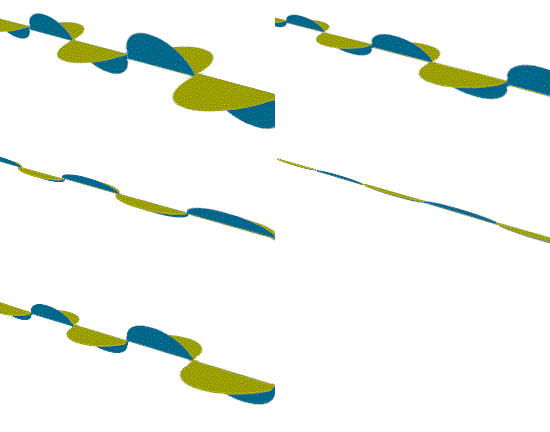
There was one stumbling block. Such a wave could not exist in empty space, because empty space contained no copper wires and could not carry the currents needed to complete the above cycle. A brilliant young Scotsman, James Clerk Maxwell, solved the riddle in 1861 by proposing that the equations of electricity needed one more term, representing an electric current which could travel through empty space, but only for very fast oscillations. With that term added (the "displacement current"), the equations of electricity and magnetism allowed a wave to exist, propagating at the speed of light. The drawing below illustrates such a wave--green is the magnetic part, blue the electric part--the term Maxwell added. The wave is drawn propagating just along one line. Actually it fills space, but it would be hard to draw that.
Maxwell proposed that it indeed was light. There had been earlier hints--as noted above, the velocity of light had appeared unexpectedly in the equations of electricity and magnetism--and further studies confirmed it. For instance, if a beam of light hits the side of a glass prism, only part of it enters--another part gets reflected. Maxwell's theory correctly predicted properties of the reflected beam. Then Heinrich Hertz in Germany showed that an electric current bouncing back and forth in a wire (nowadays it would be called an "antenna") could be the source of such waves. (The current also produces a magnetic field in accordance with Ampere's law, but that field decreases rapidly with distance.) Electric sparks create such back-and-forth currents when they jump across a gap--hence the crackling caused by lightning on AM radio--and Hertz in 1886 used such sparks to send a radio signal across his lab. Later the Italian Marconi, with more sensitive detectors, extended the range of radio reception, and in 1903 detected signals from Europe as far as Cape Cod, Massachussets. It was presumed that light from the hot wire of a lightbulb was emitted because the heat caused electrons to bounce back and forth rapidly, turning each into a tiny antenna. When physicists tried to follow that idea, however, they found that the familiar laws of nature had to be modified on the scale of atomic sizes. That was how quantum theory originated. Gradually other electromagnetic waves were found The wave nature of light causes different colors to be reflected differently by a surface ruled in fine parallel scratches--which is why a compact laser disk (for music or computer use) shimmers in all colors of the rainbow. The orderly rows of atoms in a crystal also form parallel lines but spaced much more closely, and they turned out to have the same effect on X-rays, showing that X-rays, like light, also were electromagnetic waves, but of a much shorter wavelength. Later it was found that beams of electrons in a magnetic field, inside a vacuum tube, could become unstable and emit waves longer than light: the magnetron tube where this occured was a top-secret radar device in World War II, and it later made the microwave oven possible. Electromagnetic waves led to radio and television, and to a huge electronic industry. But they are also generated in space--by unstable electron beams in the magnetosphere, as well as at the Sun and in the far-away universe, telling us about energetic particles in distant space, or else teasing us with unresolved mysteries. You can find more about this in the section on high energy particles.
|
|
Next Stop: #7. Plasma
Authors and Curators:
|
This joined-up file created June 9, 2001