#7.     Plasma

Plasma is sometimes called "the fourth state of matter", beyond the familiar three--solid, liquid and gas. It is a gas in which atoms have been broken up into free-floating negative electrons and positive ions, atoms which have lost electrons and are left with a positive electric charge.

In the lower atmosphere where we live, any atom that loses an electron (say, by being hit by a fast cosmic ray particle) soon recaptures it or one like it. The situation is quite different at high temperatures, such as exist on the Sun. The hotter the gas, the faster its atoms and molecules move, and at very high temperatures, the collisions between such fast-moving atoms are violent enough to rip off electrons. In the Sun's atmosphere, a large fraction of the atoms at any time is "ionized" by such collisions, and the gas acts as a plasma.

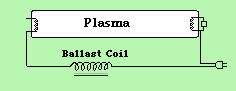
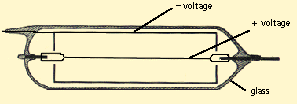
Unlike cool gases (e.g. air at room temperature), plasmas conduct electricity and are strongly affected by magnetic fields. The fluorescent lamp, widely used in the home and at work, contains a rarefied inert gas with a fraction of a percent mercury vapor, which produces a plasma when heated and agitated by electricity, from the power line to which the lamp is connected. The power line makes one end electrically positive, the other negative (see drawing below) causing (+) ions to be accelerated towards the (-) end, and (-) electrons to the (+) end. The accelerated particles gain energy, collide with atoms, eject additional electrons and thus maintain the plasma, even if some other particles re-combine. The collisions also cause mercury atoms to emit light, and in fact, this source of light is more efficient than conventional lightbulbs. Neon signs and streetlights operate on a similar principle, and some plasma devices are (or were) used in electronics.


A fluorescent lamp.

[In case you ask: when the fluorescent lamp is first turned on, the gas is cold, but a few free ions and electrons are always present, due to cosmic rays and natural radioactivity. The filaments at the ends also release electrons. Collisions quickly multiply their number.
  And it is true that since alternating current is used, the location of (+) and (-) in the above drawing switches back and forth 60 times each second. However, ions and electrons respond much faster than that, hence the process stays the same. Click here for more about the fluorescent lamp]

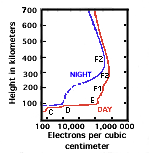
As noted, the Sun consists of plasma. Another important plasma in nature is the ionosphere, starting about 70-80 km above ground. Here electrons are torn off atoms by sunlight of short wavelengths, ranging from the ultra-violet to X-rays: they do not recombine too readily because the atmosphere becomes increasingly rarefied at high altitudes and collisions are not frequent. The lowest part of the ionosphere, the "D layer" at 70-90 km, still has enough collisions to cause it to disappear after sunset. Then the remaining ions and electrons recombine, while in the absence of sunlight new ones are no longer produced. However, that layer is re-established at sunrise. Above 200 km, collisions are so infrequent that the ionosphere persists day and night.

A profile of the ionosphere.
The topside ionosphere extends many thousands of km into space and merges with the magnetosphere, whose plasmas are generally more rarefied but also much hotter. The ions and electrons of the magnetospheric plasma come in part from the ionosphere below, in part from the solar wind (next paragraph), and many details of their entry and heating are still unclear.

Finally, there exists the interplanetary plasma--the solar wind. The outermost layer of the Sun, the corona, is so hot that not only are all its atoms ionized, but those which have started off with many electrons have several of them (sometimes all of them) torn off, including deeper-lying electrons which are more strongly attached. For instance, characteristic light has been detected in the corona from iron which has lost 13 electrons.

This extreme temperature also prevents the plasma of the corona from being held captive by the Sun's gravity, and instead it flows out in all directions, filling the solar system far beyond the most distant known planets. Through the solar wind the Sun shapes the Earth's distant magnetic field, and the wind's fast flow (~400 km/s) supplies the energy which ultimately powers the polar aurora, the radiation belts and magnetic storm phenomena.

Further reading:

Plasma physics is a difficult, mathematical field, whose study requires a thorough understanding of electromagnetic theory. Some college texts on electricity and magnetism deal with aspects of plasma physics, e.g. chapter 10 of "Classical Electrodynamics" by J.D. Jackson.

Optional detour: #7a.  The Fluorescent Lamp: A plasma you can use

Next Stop: #7H.  Plasma--History

----------------------------------------

#7a.   The Fluorescent Lamp:
      A plasma you can use


A fluorescent lamp.

You may have noticed in the drawing (reproduced here) that the circuit of the fluorescent light fixture included a "ballast coil.," You might also have noticed such coils in fixtures in your home, often encased in a rectangular box. Ordinary hot-filament lightbulbs are connected directly to power lines, but fluorescent lamps always receive their current through a ballast. Why?


Good question. If you have studied electricity, you surely learned there about Ohm's Law, by which the current flowing through a device is inversely proportional to its electrical resistance R. Double the resistance R and only 1/2 of the current gets through, replace it with one 10 times larger and only 1/10 as much manages to flow. It is a bit like water flowing in a pipe--if you make the pipe 10 times narrower, then (other things being equal) only 1/10 as much water flows through.

  Well, in case you thought that Ohm's law was a universal law of electricity--think again, because it isn't. Metal wires satisfy it fairly well, although their resistivity varies with temperature: a cold lightbulb filament has only 1/5 the resistance of a hot one, so that initially the lamp draws a 5-fold current, which helps switch it on quickly. But plasmas do not satisfy it at all. The resistance of your fluorescent lamp is not fixed, it depends on the current carried: the greater the current, the smaller the resistance.

  Put in other words, the plasma is a greedy conductor of electricity. Suppose it has just enough free electrons to get a current started. The current causes ions and electrons to move rapidly and to collide violently, and those collisions strip additional electrons off atoms of the gas. Additional electrons increase the current, causing more collisions and producing still more electrons, which create more current, more and still more... In this way, if a fluorescent lamp were directly connected to the power lines, unprotected, its current would rapidly grow until something gave way. The tube might heat up and explode, the wiring might melt... or more likely, the fuse or circuit breaker which protect the fixture would stop the current.

  A resistor connected in front of the tube, in place of the ballast coil in the drawing, would prevent this from happening. Imagine our power comes from a 110 volt line, and the resistance in front is 220 ohms: then even if the effective resistance of the plasma falls to zero (and it can't fall any further!), the current drawn is only (110volt/220 ohm) = 0.5 ampere. If the plasma adds its own non-zero resistance, that makes the denominator larger and the current even smaller.

  Why then a coil and not a resistor? Because the tube is fed by an alternating voltage, which rises and falls 120 times a second (in the USA; 100 times in Europe). Its electrical current sloshes back and forth, 60 times a second in one direction, 60 times in the opposite one. In between, 120 times each second, the voltage drops to zero and the tube is extinguished, since plasmas react very quickly. Somehow, it must be relit!

  A ballast coil can do that. In an alternating current, it acts a bit like a resistance. As the current rises, it absorbs energy from it to build up its magnetic field, slowing down its growth. Then, when the voltage drops to zero, the stored magnetic energy produces a voltage surge which relights the tube. You will not usually see the fast flickering of the light, except maybe if you illuminate a rotating fan, when (at the right speed) its motion seems to stop.

  And what about this "fluorescent" thing? The mercury atoms in the plasma generate light very efficiently, but much of it is ultra-violet (UV), invisible to the eye and harmful to it (or rather, it would be, were it not absorbed by the glass). The solution is to coat the inside of the tube with a glow-in-the-dark (fluorescent) paint, which absorbs the UV and re-emits its energy as visible light.

  All other plasma lamps--sodium and mercury streetlights, neon lights etc.--require ballast coils, too. Recently, small fluorescent lamps have appeared on the market, which screw into the socket of a regular lighbulb. They have transistor circuits replacing the coil, and although they cost more than filament lamps, they are (like other fluorescent lamps) much more eficient.

    (And if you think Ohm's law is badly violated by fluorescent lamp plasmas--just wait till you read about the ring current, the electric current carried around Earth by trapped ions and electrons of the radiation belt. That current needs no voltage at all, it circulates just because of the trapping of the plasma!)

A few words about safety

  If a fluorescent lamp were not protected by a ballast, it could in principle draw a huge current. Occasionally (not too frequently), a ballast coil fails badly, the circuit breaker fails to do its job and a fire is caused. The usual sign of a failing coil is a loud hum from the fixture. The reason: to prevent parasitic currents, the coil is wrapped not around a solid iron core, but around a stack of iron plates, insulated from each other by a tar-like substance. On some old fixtures, those plates work loose and start vibrating at the frequency of the alternating current, which to our ears sounds like a deep hum. Violent vibrations may scrape the coils wrapped around them and allow the plasma to carry a greater current.

  A low-intensity hum is probably no cause for alarm, although it can be annoying. But if the hum gets really loud, it my be safer to replace the coil or the fixture. Electric transformers are also constructed around stacked iron plates and are subject to the same problem.

Next Stop: #7H.  Plasma--History

----------------------------------------

#7H.     Plasma Physics -- History

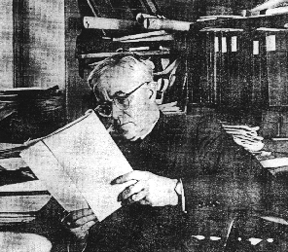
When blood is cleared of its various corpuscles there remains a clear liquid, named "plasma" by the great Czech medical scientist, Johannes Purkinje (1787-1869). The use of the term "plasma" for an ionized gas started in 1927 with Irving Langmuir (1881-1957), an American whose achievements ranged from the chemistry of surfaces to cloud seeding for promoting rain, and who in 1932 won the Nobel prize for chemistry. Langmuir worked for the General Electric Co., studying electronic devices based on ionized gases, and the way the electrified fluid carried high velocity electrons, ions and impurities reminded him of the way blood plasma carried red and white corpuscles and germs.


Irving Langmuir

As a result of those studies, carried out on relatively cool and dense plasmas, scientists nowadays can talk of "Langmuir waves" and fly "Langmuir probes" aboard satellites. Gradually plasma research spread in other directions, of which three were particularly significant.

First, the development of radio led to the discovery of the ionosphere, the natural "plasma roof" above the atmosphere, which bounces back radio waves and sometimes absorbs them. Starting with the study of the propagation of radio waves in the ionosphere, a wide variety of plasma waves was identified, in general spreading differently along magnetic field lines than perpendicular to them.

Second, astrophysicists recognized that much of the universe consisted of plasmas, and that understanding astrophysical processes required a better grasp on plasma physics. This was particularly true for the Sun, whose intensely magnetic sunspots produced many intricate plasma phenomena (e.g. solar flares).

Finally, the creation of the atomic bomb raised great interest in nuclear energy as a possible source of power for the future. The Sun releases its energy by combining hydrogen nuclei to form helium, but this thermonuclear fusion process needs enormous temperatures and pressures, like those found at the center of the Sun. The process is easier in a gas consisting of the heavy forms (isotopes) of hydrogen, but even there, such enormous temperatures are needed that no laboratory container could hold the gas--either the container would vaporize, or (more likely) it would cool the gas to where all nuclear fusion stopped.

However, since gas at such a temperature becomes a plasma, the idea arose to hold it trapped inside a magnetic field, without it actually touching any material walls. The effort to produce such "controlled thermonuclear fusion" started with "Project Sherwood" of the early 1950s and has grown into a great international undertaking, with thousands of scientists and huge, sophisticated machines. Gradually ways were found to foil the different modes by which the magnetic field rapidly spilled its plasma, and both the temperature and density of the plasma were slowly increased. Recently a fusion experiment managed to extract as much fusion energy as was invested in the plasma, but we are still a long way from commercial use of such energy.

When satellites discovered the radiation belt and began exploring the magnetosphere, a fourth direction opened, space plasma physics. From fusion research, space scientists borrowed the theory of plasma trapping by a magnetic field, and from ionospheric physics, the theory of plasma waves. Astrophysics provided, among other things, notions of magnetic processes for energy release and particle acceleration. Today space plasma physics is an active field, contributing to the understanding of not just observations in space but also of plasmas in general.

Further reading:

Irving Langmuir's coining of "plasma" was described by Harold M. Mott-Smith in a letter to Nature, vol. 233, p. 219, 17 September 1971.

The founding of "Project Sherwood" is described on p. 217-220 of the autobiography of John Archibald Wheeler, "Geons, Black Holes and Quantum Foam" (Norton and Co., 1998). The book itself tells a fascinating and inspiring story, the life of a scientist who was involved in many frontier areas of physics.

Next Stop: #8.  Positive Ions

----------------------------------------

#8.     Positive Ions

Matter is made of atoms. Each atom, in its turn, is made of electrically charged components:

  • a positive central nucleus, where most of the atom's mass is concentrated, and
  • one or more negative electrons.
Nucleus and electrons are held together by the electric attraction between positive (+) and negative (-) charges. In any atom, the two charges are exactly balanced, so that to the outside world the atom is electrically neutral.

Ions help gases conduct electricity

When an atom is hit by a fast-moving particle, like those emitted by radioactive materials, or absorbs light, an electron may be torn off. What is left is an electrically charged atom or "ion," carrying a positive charge, and the process is known as "ionization."

When such processes occur in air, they produce there free ions and electrons, which can move and carry an electric current, something neutral atoms cannot do. Air is usually an excellent electrical insulator, but with ionization present, electric charges can leak through it.


The Electroscope

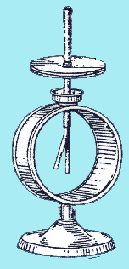
This leakage was used, around 1900, to detect radioactive emissions and measure their intensity. The drawing below shows a simple instrument for performing such measurements. It is called an electroscope and contains two parallel leaves of metal foil, protected from wind inside a metal box with transparent windows and attached to a metal rod insulated from the box and leading outside (drawing).

When the plate at the end of the rod is electrically charged (e.g. by rubbing it with a dry cloth), the leaves spread wide apart, since both carry electric charges of the same sign and repel each other. However, when a radioactive substance is brought close, the electric charge leaks to the box and the leaves gradually drop down again.

Ion types

Hydrogen, the simplest atom, has one electron. When that electron is removed, we get the simplest positive ion, the "proton"; like the electron, it is a fundamental particle, but 1836 times heavier. The chemical symbol for hydrogen is H, but for the proton it is H+.

The next heavier atom is that of helium (chemical symbol He) and it contains two electrons. Its nucleus consists of two protons and also two neutrons, particles similar to the proton but with no electric charge. The Sun gets its energy by combining protons (some of which convert to neutrons in the process) into helium, deep in the Sun's core; since the helium nucleus is an unusually stable combination of particles, energy is released in the process.

The completely ionized helium atom He++, missing both electrons, is also known as the "alpha particle" (see history section). Just as in the Sun and in most stars, hydrogen is the most abundant element with helium next, so the solar wind consist mostly of protons, with 5% alpha particles and small numbers of heavier ions.

A somewhat similar composition exists among cosmic rays, a very thin drizzle of ions moving close to the speed of light and bombarding the Earth from all directions; they probably fill our galaxy and their origin is uncertain.

It may be mentioned that in addition to such atomic ions, there also exist molecular ions of either sign, formed when intact molecules lose or gain an electron. Such ions occur in ionospheric processes.

Clouds of barium ions

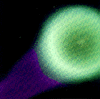
An atom can become ionized by the absorption of light. The atom of barium is particularly easy to ionize, because its outermost electron is very loosely bound. If a mass of barium is vaporized in space, producing a barium cloud, much of the barium becomes ionized by sunlight within less than a minute. The cloud then moves in response to electric forces in space, and can be used to study the electrical field in space.

In practice the barium is packed into canisters with copper oxide, and these are released from rockets or satellites and ignited. The resulting chemical reaction produces great heat, but more barium is packed into the canister than can combine chemically, and some the excess is vaporized to form a large spherical greenish cloud.

Typically the release is done after sunset or before sunrise, so that while the canisters explode in full sunlight, observers on the ground can watch the cloud against the dark sky: soon a bluish ion cloud separates from the green one, usually elongated or striped in the direction of the magnetic field lines, which guide the ions.

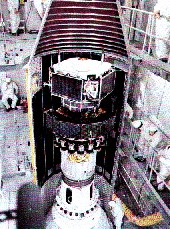
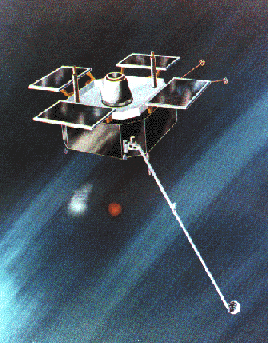
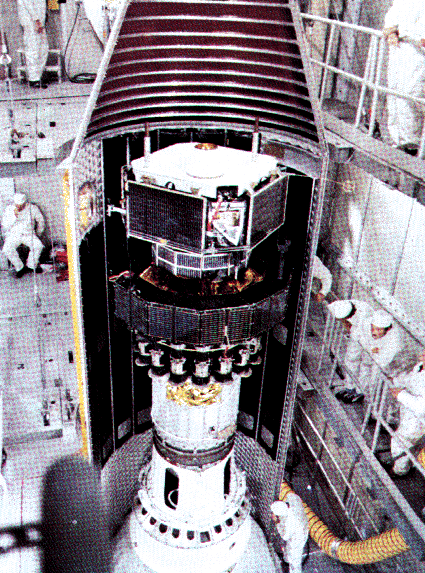
Some barium releases are conducted far from Earth and are tracked by telescopes. The AMPTE mission (Active Magnetospheric Particle Tracer Experiment), launched in 1984, released barium clouds near the "nose" of the magnetosphere and in the magnetospheric tail.

The AMPTE mission included three spacecraft, shown here stacked up during launch. Click here for a full size version of this image.

In addition it released a barium cloud in the solar wind to produce an "artificial comet". Soon after the cloud formed, the magnetic field embedded in the solar wind picked it and made it share the wind's flow, a process similar to the one which creates the ion tails of comets (see solar wind, history).


The AMPTE Charge Composition
Explorer (CCE) satellite


Further Exploring

    This section starts with the words "Matter is made of atoms." Actually it took about a century, many experiments and some clever deductions to arrive at that conclusion! It would be completely impossible to tell the entire story here, but you might want to look at a brief sketch of the steps which led to the atomic theory, part of material prepared for teachers in a different course.

Next Stop: #8H.   Positive Ions--History

----------------------------------------

#8H.     Positive Ions--History

Ions in chemistry

The notion of ions first arose in chemistry. In the 19th century it was well known that water in which salts were dissolved (or acids, or bases) conducted electricity, and that an electric current could separate such dissolved materials into their components. Faraday formulated the laws of such processes.

But how, and why?

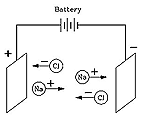
The answer was given in 1884 by Svante Arrhenius (1859-1927), a many-talented Swede who received the 1903 Nobel prize for chemistry and who (among his many achievements) first suggested the "greenhouse effect." Arrhenius proposed that when a compound like table salt NaCl (sodium chloride) was dissolved in water, it broke up into electrically charged "ions" (Greek for "the ones that move") Na+ and Cl-. Electric forces made Na+ ions move in one direction, Cl- ions in the opposite one, and that was how the electric current was carried.

Although at first this seemed like a strange idea, today it is quite well understood. Many chemical molecules are formed when atoms share electrons, but molecules such as those of NaCl are different. There, the sodium atom (Na) gives up an electron to the chlorine (Cl), creating ions Na+ and Cl-, which in solid salt are held together by their electric attraction. Water, however, greatly weakens that attraction (on a microscopic scale), allowing the ions to drift free whenever salt is dissolved in water, and allowing the water to conduct electricity.

Ions in a plasma

In plasma discharges in rarefied gases (like those in fluorescent tubes) ions are also produced. J.J. Thomson, who discovered the electron, later (1907-11) produced narrow beams of protons in a near-vacuum and studied their reaction to magnetic and electric forces.

Today, of course, proton beams are routinely produced and accelerated to very high energies, in huge machines like the "Tevatron" south of Chicago and the accelerators of CERN (Europe's center for nuclear research) near Geneva. Some of them are allowed to smash into targets, to study the structure of matter and produce a variety of "new" particles. Another "cleaner" mode of studying them is to cause a head-on collision between a beam of protons and another one of antiprotons, "antimatter" particles resembling protons but with a negative charge. The proton-antiproton collision is cleaner because it only involves two relatively simple particles, but the antiprotons must first be produced by some other high-energy collisions, since they do not usually exist in nature.

Ions emitted by radioactivity

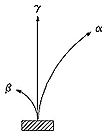
Radioactivity was discovered in 1895, when it was found that heavy elements such as uranium emitted "rays" which could ionize air and fog photographic film. In 1898 Ernest Rutherford noted that the radiation seemed to contain two electrically charged components of opposite signs, steered by a magnet in opposite directions--positive "alpha rays" and negative "beta rays."

Ultimately beta rays were identified as electrons and "alpha particles" as completely ionized helium nuclei; a third component, "gamma rays" unaffected by magnets, turned out to be related to light and X-rays. For his work on radioactivity, Rutherford was awarded a Nobel prize in 1908.

Alpha particles

It was later found that heavy nuclei such as uranium were made unstable by the large number of protons they contained (being all positive, the protons repel each other). Such nuclei therefore expelled some of their extra protons in the form of alpha particles, which (as noted) form an extremely stable configuration. Alpha particles released by rocks underground ultimately find electrons and settle down as ordinary helium atoms, dispersed in the Earth's crust. Some of this helium finds its way into natural gas, and it can be extracted from there for a variety of uses. Thus practically all of the helium gas used in toy balloons once started out as alpha radiation!

Further reading:

  • "From X-rays to Quarks" by Emilio Segre, a history of modern physics, including that of radioactivity and accelerators. Clearly and engagingly written by a Nobel prize winner, but not always easy for the non-scientist.
  • "The God Particle" by Leon Lederman with Dick Teresi, the same story told by another Nobel laureate, but in a rather light-hearted and irreverent style.
  • An elementary exposition on nuclear physics can be found in the sister-site of "Exploration of the Earth's Magnetosphere", titled "From Stargazers to Starships," in the section on solar energy and the following optional section on nuclear energy.

Next Stop: #9.  Trapped Radiation

----------------------------------------

#9.     Trapped Radiation

Charged particles--ions and electrons--can be trapped by the Earth's magnetic field. Their motions are an elaborate dance--a blend of three periodic motions which take place simultaneously:
  1. A fast rotation (or "gyration") around magnetic field lines, typically thousands of times each second.
  2. A slower back-and-forth bounce along the field line, typically lasting 1/10 second.
  3. A slow drift around the magnetic axis of the Earth, from the current field line to its neighbor, staying roughly at the same distance from the exis. Typical time to circle the Earth--a few minutes.

(1)   Circling around magnetic field lines.

Electrons and ions, of the energies commonly encountered in the magnetosphere, tend to circle around magnetic field lines. Like the motion of planets around the Sun, this motion too can sustain itself with no energy input, and can therefore (in principle) persist for a long time.

Opposite charges circle in opposite directions; around a field line pointing towards the viewer, ions circle clockwise, electrons counterclockwise.


(2)   Bouncing back and forth between "mirror points."

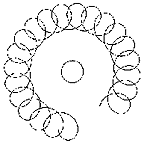
As such particles circle their guiding field line, the "guiding center" of their rotation generally slides up or down that line, creating a typical spiral pattern. However, a subtle interaction causes the spiraling particle to be repelled from regions of stronger magnetic field, where field lines converge.

 Because a particle is repelled as it moves into a region of stronger field, its advance along its guiding field line slows down. Its sliding velocity finally drops to zero and then reverses, causing the particle to bounce back or "mirror."

Without this sort of "mirroring," ions and electrons would not be trapped in the Earth's magnetosphere, but would instead follow their guiding field lines into the atmosphere, where they would be absorbed and become lost. What happens instead is that every time a trapped particle approaches Earth, it is reflected back. It is thus confined to the more distant section of the field line.


(3)   Drift around the Earth

In addition to the rapid rotation ("gyration") around field lines and the back-and-forth "bounce" motion, trapped particles also undergo a slow "drift", by which they jump from one field line onto another one nearby, similar to the original one but slightly rotated around the Earth's magnetic axis. Viewed from the north pole, a positive ion will gradually rotate clockwise, a negative electron counter-clockwise.

The ring current

Because positive ions and negative electrons drift in opposite directions (see drawing), that motion will create an electric current that circulates clockwise around the Earth when viewed from north. The current is aptly named the ring current.

Note how different electric currents in space are from those encountered in everyday life! Currents we use at home--for light, to drive machinery or to generate heat--only flow if pushed by an electric pressure or voltage, against the resistance of the circuitry. The flow of such currents is in many ways similar to the flow of water through a pipe--water, too, will only flow if pressure is available, to help it overcome the friction inside the pipe. The flow of both water and electricity require a constant input of energy: once we click the switch and disconnect a house current from its source of voltage, it stops practically instantly.

The flow of the ring current, and of many other currents in space, is quite different. It needs neither a driving voltage nor an energy input, but persists as long as its ions and electrons are trapped in the magnetic field. Many aspects of such "collision-free plasmas" are quite unlike what one might expect, and are often hard to reproduce in the laboratory: that is why the magnetosphere is probably our best "natural laboratory" for studying the processes of distant space.

Magnetic storms

The magnetic field produced by the ring current contributes (rather slightly) to the magnetic field observed at the surface of the Earth. There are however times when the population of trapped particles is greatly reinforced. The ring current then becomes stronger and its magnetic effect at Earth may grow 10-fold or more: that is known as a magnetic storm. The reinforcing particles are generally of moderate energy, but can be quite numerous. As discussed in a later section such events can interfere with the operation of communication satellites and cause other problems.

If trapped orbits are so stable that their particles cannot be easily lost, those particles should not be able to easily enter them, either. How then can the radiation belt and ring current arise?

The inner radiation belt, discovered by Explorers 1 and 3, turns out to be a slowly accumulating by-product of cosmic radiation, as explained in a later section.

The ring current however (its energetic part is often called the "outer radiation belt"), owes its existence to magnetic storms, which can replenish it in the matter of hours. The process by which that happens is still incompletely understood, but it involves electric forces, combining with magnetic ones. Electric fields are able to push trapped particles earthward, and unlike the purely magnetic motion described earlier, an electric field can also energize them.

The ultimate source of the energy and electric field must be the solar wind, and theories exist to explain how they are transmitted. Some are mentioned in further sections, but many details are still unclear and controversial.

Further reading:

A proper understanding of the motion of ions and magnetic fields requires a fair amount of mathematics. Texts on plasma physics generally cover the main principles, though some aspects important to the trapping of particles in the Earth's field may not be included.

For a non-mathematical overview of some of the physical principles involved, especially the notion of adiabatic invariants, click here.

Next Stop: #9H.  Trapped Radiation--History

----------------------------------------

#9H.     Trapped Radiation -- History

The trapping of particles by magnetic fields was first studied by Kristian Birkeland in Norway, starting around 1895. Birkeland aimed beams of electrons (called "cathode rays" in those days) at a magnet inside a vacuum chamber, and noted that they seemed to be channeled towards its near magnetic pole. He then asked his former teacher, the renowned French mathematician Henri Poincaré, to examine their motion. Poincaré managed to solve the motion of charged particles near an isolated magnetic pole, showing that they spiraled around field lines and that they were repelled from regions of strong field.

Stoermer's Calculations

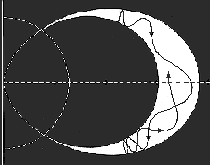
An isolated magnetic pole is a mathematical abstraction and has not been observed (though a few people keep trying). Later Birkeland built bigger vacuum chambers and replaced the magnet with a magnetized sphere or "terrella" representing the Earth, noting that the electrons were channeled towards both its poles. A more practical problem, therefore, was particle motion near a compact bar magnet or "dipole", which better modeled the field of the Earth or of his terrella. Birkeland therefore suggested that problem to a friend, the mathematician Carl Stoermer, who devoted to it an appreciable part of his career. Stoemer never found a full solution, a formula which would predict the particle's motion to all time, like the formula for the motion of a single planet around an isolated sun. In fact, none exists in conventional mathematical terms, because the motion is inherently intricate (in today's terms, a "chaotic motion," an area pioneered by Poincaré). But he did show that large families of orbits would remain trapped forever.

The orbits Stoermer was most concerned with belonged to particles with rather high energies. In general they did not resemble tidy spirals, because they covered large sections of the magnetic field, and in the course of each excursion around the field, the intensity and direction of the magnetic field did not stay the same but varied appreciably. Later, when cosmic rays were discovered, it turned out that Stoermer's theory applied quite well to their motion: but it did not solve the mystery of the polar aurora, as Stoermer had hoped.

Scientists in those days also wondered whether trapped particles were the cause of the mysterious "ring current" responsible for magnetic storms, but it was hard to imagine a process which created enough ions or electrons of cosmic ray energies to sustain them. Only in 1957 did S. Fred Singer (U. of Maryland) propose that the ring current may be carried by particles of much lower energies, injected somehow into trapped orbits during magnetic storms. In the following year the radiation belt was discovered--existing all the time, not just during storms--and gradually the details fell into place.

Meanwhile in the 1950s efforts began to confine plasma in laboratory magnetic fields for producing controlled nuclear fusion, and in the process the theory of trapped particles was greatly developed and expanded.

Project Argus

Perhaps the most interesting story of that era concerns Nicholas Christofilos, a Greek elevator engineer whose avocation was the study of particle motion in magnetic fields. Pursuing those studies he discovered "strong focusing," now a widely-used method of controlling beams of energetic ions in accelerators. He communicated this to scientists in the US, but received little attention until the principle was independently re-discovered. He then came to the US and worked for the rest of his career on various aspects of magnetic trapping of particles, in particular the trapping of plasma in devices intended to release fusion energy (see plasma).

As a grand experiment he proposed in October 1957 to the US Air Force to launch rockets with small atomic bombs, and detonate them in space. Atomic bombs produce large numbers of energetic electrons, and Christofilos hoped that such electrons would become trapped in the magnetic field as an artificial radiation belt.

That project, conducted in secrecy and code-named Argus, received a great boost when Van Allen's Explorers 1 and 3 discovered the natural radiation belt, and it was carried out above the Southern Atlantic in August and September 1958. Three bombs were exploded outside the atmosphere, above a deserted stretch of ocean, and the public only learned about it the following year, when many related scientific studies were published.

The bombs indeed produced many high-energy electrons. Some of these were guided upwards along magnetic field lines, followed those lines across the equator and came down again near the Azores islands, where a remarkable artificial aurora was seen, in a region where no auroras had ever been observed before. Other electrons mirrored above the atmosphere and stayed trapped, creating artificial radiation belts which gradually decayed in the matter of weeks. The new belts were studied by the satellite Explorer 4, built for this purpose by Van Allen's group at the University of Iowa.

  Van Allen kissing
  Explorer 4 good-bye.

Further reading:

  • On the work of Birkeland and Stoermer, with references to other sources: David P. Stern, "A Brief History of Magnetospheric Physics before the Spaceflight Era", Reviews of Geophysics, vol. 27, 103-114, 1989.
  • Note on Birkeland's terrella experiment
        Birkeland constructed several terrella experiments, including (in 1913) a large one in a big chamber, shown next to his picture on the current Norwegian 200-kroner bill. That terrella was restored in 1995 by Terje Brundtland and has been demonstrated to visitors at the Auroral Observatory in Tromsø, Norway. For an article about that restoration, see here.

  • A collection of articles on project "Argus" appeared in the Journal of Geophysical Research, vol. 64, August 1959. It is headed by an overview by N. Christofilos (p. 869) and a report on the observations of Explorer 4, by James Van Allen, Carl McIlwain and George Ludwig (p. 877).
  • The obituary of Nicholas Christofilos appeared in Physics Today, January 1973.

Next Stop: #10.  Motion of Trapped Radiation

----------------------------------------

#10.     Principles of the Magnetic
Trapping of Particles

  A full explanation of the motion of trapped particles is far too abstract and mathematical for this level, but some basic ideas may be described on an intuitive level.

Circular motion

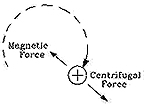
      The magnetic force on a moving particle is always perpendicular to the motion, as well as to the magnetic field lines. That is why the basic pattern is motion in a circle, around a magnetic field line. In the motion of a satellite circling the Earth above the atmosphere, gravity always balances the centrifugal force. Similarly with the charged particle, the magnetic and centrifugal forces are always balanced.

  Because the force is perpendicular to the velocity, it can only change the direction of motion, not its speed or energy. Because no energy is needed to keep up the motion, it can (in principle) persist indefinitely.

Mirroring

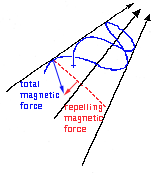
  The fact that the magnetic force is perpendicular to magnetic field lines means that when a particle spirals around a cone of converging field lines, that force is always slightly tilted backwards (drawing).

  The motion of ions on
  coverging field lines.

By the laws of motion, any force can always be resolved into the sum of mutually perpendicular forces, each controlling the motion in its direction. The "radial force" perpendicular to the axis of the cone (drawing) keeps the ion or electron turning in a circle around that axis, and is balanced (as noted above) by the centrifugal force of that rotation.

  In addition, however, there will also exist a small force parallel to the axis, repelling the particle away from the tip of the cone. That added force gradually slows down the particle's advance down the axis and finally reverses it, causing it to "mirror" and bounce back.

  Throughout all this, the total speed of the particle stays unchanged. Out in space, it usually takes electric forces, not just magnetic ones, to change the total speed and energy of the particles.

Adiabatic Invariants

  There exists a different and somewhat more abstract manner of reaching the same result. The period T of rotation, the time required by the particle for one circuit around its guiding field line, becomes shorter as the particle approaches the tip of the cone. After all, the total speed of the particle is unchanged, its rotation speed nearly so, while the distance covered by one circuit gets shorter and shorter near the tip.

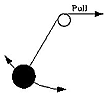
In the theory of motions, this is an example of a periodic motion whose period gradually decreases. The best-known periodic motion is the back-and-forth swing of a pendulum, say of a weight suspended by a string (drawing). The shorter the string, the shorter the time of each swing ("period"), which goes like the square root of the length. One can replace the support point with a pulley wheel, which is gradually lowered and its string shortened (ignore the word "pull" which is explained further below). The bottom of the swing stays in the same height, but the period gets shorter and shorter.
  It turns out that the product T x E, the period T times the energy E, is almost a constant. It is not an exact constant, like total energy in a system, but if the rate of change is slow enough, e.g. if the string is pulled rather slowly, it comes very close.

  The motion of electrons and ions spiraling around magnetic field lines is also periodic. While the period of a pendulum changes when its string gets longer or shorter, that of a spiraling ion or electron changes as it moves into regions where the magnetic field is weaker or stronger. Just as for a pendulum the product T x E stays very nearly constant, so here too, a certain quality, an "adiabatic invariant," is almost kept at a constant value. From that constancy it is possible to deduce the "mirroring" of particle and many other properties of their motion.


Note on the above illustration

  Many books give this example but state that the string is pulled up, over the wheel, while the pendulum is swinging. This is a more complex situation. As the pendulum swings, it generates a centrifugal force, and the pull on the string, besides lifting the weight to a higher average position (which increases the potential energy), also has to overcome the resistance of the centrifugal force. That requires an extra input of energy from the force pulling the string, and since energy has to go somewhere, it makes the swing of the pendulum more vigorous.

  That is somewhat similar to the case of the lowered support, but the calculation gives a diferent rate. With the lowered support, work is also done--but that happens when the weight is pulled in from the sides to swing in a shorter arc, not at the bottom of the swing.

  The process described here is related to the way children "pump" a swing to make it go higher. The child moves arms, legs and body in a way that works against the centrifugal force, and the energy invested in overcoming this force ends up producing a more energetic swinging motion.

  (This is a highly simplified explanation and assumes that from the point of view of the child in the swing, nature behaves exactly the same as anywhere else, only a centrifugal force is added. The actual situation can be more complicated.)

Furthr Explorations

The "Exploratorium" science museum in San Francisco has a small swing (too small to carry a person) that can be "pumped" from the outside. The seat of the swing, instead of hanging by two ropes or chains, is attached to the axis by two smooth parallel rods.

  Above the regular swing seat is a second seat, with two wide holes threaded by the two rods. Under normal circumstances, the second seat will drop to the bottom, on top of the regular one. However, a rope is connected to its middle, going over the bar from which the swing hangs and down again, and a person standing next to the swing can pull that string or let it go, making the second seat rise along the rods or fall down again.

  With your hand, you set the swing moving with moderate motion. Now, by pulling the rope or letting go at suitable times in the oscillation, you can easily "pump up" the motion. You only need to pull the swing up when it passes the lowest part of its motion, and let it down again at the extreme ends of its motion, when for a brief instant it is at rest.

Next Stop: #10H.  Motion of Trapped Radiation--History

----------------------------------------

#10H.  The Motion of Magnetically
            Trapped Particles -- History

Going in circles

The fact charged particles circle around field lines was well known to J.J. Thomson when he experimented with electron and ion beams in a magnetic field. In 1930 Ernest Lawrence of Berkeley applied such circular motion to a machine in which he accelerated ions to high energies and which he named "cyclotron." Higher energy particles describe bigger circles, so over the years, as accelerators achieved higher and still higher energies, cyclotrons and their descendants greatly increased in size.

The particles inside the Tevatron at Fermilab in Illinois need a diameter of about a mile, and a much bigger machine, the SSC or "Superconducting Super-Collider", was started in Texas but left unfinished when its funds were cut off. Giant accelerators of this form, in tunnels deep underground, also exists in the European CERN facility near Geneva, where they stretch across the French-Swiss border.

The Fermilab magnet is shaped like a huge ring whose cross-section resembles the letter "c". Inside the "c", where the magnetic field is strong, is the pipe in which protons (and antiprotons) are accelerated (the "c" cradles it the way the rim of a bicycle wheel cradles the inner tube). That pipe also forms a ring about a mile across, with a vacuum on the inside. The magnet is really an electromagnet, and as the accelerated protons gain speed and energy, its electric current is gradually increased, strengthening the magnetic field in a way that keeps the orbits of the protons within the pipe.

Early History of Adiabatic Invariance:
A Detour on the Road to Explaining the Atoms

The notion of adiabatic invariance is tied with the early years of quantum theory. Light emitted from atoms (or absorbed by them) has a very well defined pattern of colors--only a few well-defined colors are involved. (For more about this, see here.) By about1910, physicists realized that these patterns indicated changes in the laws of physics as one approached atomic dimensions.

Atoms consisted of negative light electrons and heavier positive nuclei, and their electric attraction fell with distance at the same rate as gravity, suggesting that electrons orbited in ellipses the way planets orbited the Sun. However, an additional effect was predicted: electro-magnetic processes would also make the electrons constantly lose energy by "broadcasting" it into space, like a miniature radio stations. Apparently, certain orbits were immune to such losses, and light was only emitted when an electron jumped from one to the other.

The simplest pattern of emitted colors was that of hydrogen, for which a remarkably accurate formula actually existed, discovered around 1885 by a Swiss high school teacher named Johannes Balmer. In 1914 the young Danish physicist Niels Bohr (he and his brother Harald, a mathematician, were the stars of Denmark's soccer team) discovered what seemed like an explanation for the formulas. Bohr showed that Balmer's formula was obtained naturally and accurately, if one assumed a new law of nature. By that law, electron orbits were stable if the "action variables" associated with their periodic motion were an integral multiple (i.e. 1,2,3... times) of a new physical constant, one previously known from other "quantum" effects on the atomic scale. Paul Ehrnfest proposed that that rule extended to other atoms, whose multiple electrons behaved like multiple planets.

At this point Albert Einstein called attention to the pendulum whose string was gradually shortened: its "adiabatic invariant", the product E times T, was almost constant. Could it be, he suggested, that any quantity that was adiabatically conserved in large-scale nature, was exactly conserved on the atomic scale?

That led to the early quantum theory of Sommerfeld, for hydrogen and hydrogen-like atoms. However, when Max Born tried it on helium (two electrons) his results disagreed with observed colors of helium light. The successful "wave mechanics" theory of Schroedinger, Heisenberg and Born, which in 1925-6 replaced Bohr's naive (and unexplained) principle, used a completely different approach.

Re-emergence of Adiabatic Invariance:
A Useful Tool to understanding Plasmas

Adiabatic invariance again surfaced decades later, in the study of ions and electrons moving in space. As the story of Birkeland and Stoermer shows, this area held special interest to Scandinavian scientists seeking to understand the aurora. One of them was Hannes Alfvén (1970 Nobel prize) who in his 1950 book "Cosmical Electrodynamics" showed that for appropriate conditions a certain mathematical combination of the properties of ions and electrons was almost a constant.

He apparently did not realize that this was an adiabatic invariant of the sort defined by Ehrenfest: this was pointed out at about the same time by the Russian physicists Lev Landau (Nobel, 1962) and Solomon Lifshitz, as a worked-out example for the student in their textbook on the theory of fields.

A "second" adiabatic invariant, also important in the theory of radiation trapped in the Earth's field, was derived by Grad, Longmire and Rosenbluth while studying the confinement of laboratory plasma, and a related "third" invariant was introduced shortly afterwards by Northrop and Teller.

Next Stop: #11.  Explorers 1 and 3

----------------------------------------

#11.     Explorers 1 and 3

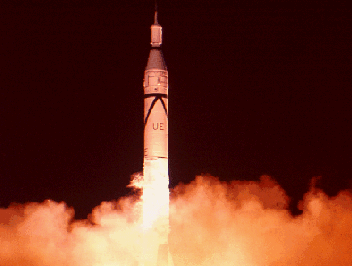
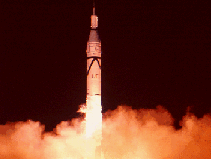
  Launch of Explorer 1
  Click here for a full size version
  of this image
In 1957 an "International Geophysical Year" (IGY) was organized, later extended to 1958, and both the Soviet Union and the USA announced their intention to launch that year artificial Earth satellites. The USSR was first, sending off its first "Sputnik" ("satellite") on October 4, followed by Sputnik II on November 3. However the official US entry, the Vanguard satellite, went up in flames in a launch failure in December. The US then authorized a back-up spacecraft mission, initiated unofficially a few years earlier by Wernher Von Braun. Von Braun had built large missiles for the US Army and had all the hardware ready, but until then was given no permission to launch a satellite.

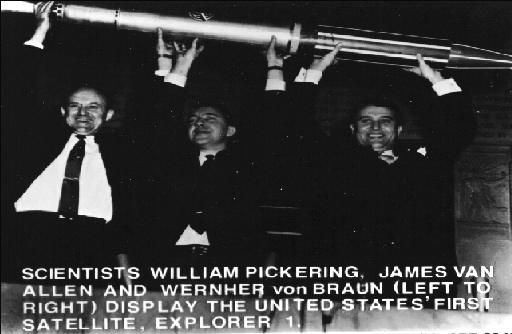
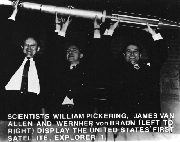
The spacecraft, named Explorer 1, was launched 31 January 1958 and was designed and built by a group of scientists from the University of Iowa, led by James Van Allen. That group had been previously credited with the first observation of auroral electrons from a rocket; incidentally, the idea of the IGY itself started in 1950 at a dinner party at Van Allen's home (at the time, near Washington).

 News conference following
 the launch of Explorer 1;Click
 here for a full size version.
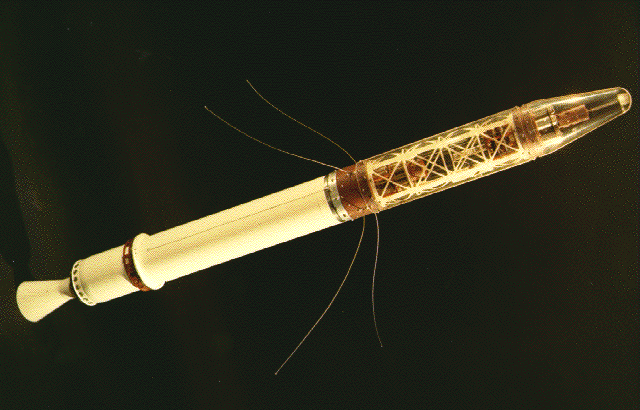
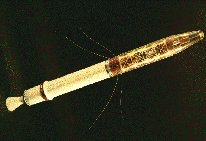
Van Allen equipped the spacecraft with a Geiger counter, a device for detecting high-energy ions and electrons. The goal was to measure the intensity of cosmic rays, fast ions that come from space, and in particular its variation with distance from the magnetic equator. Van Allen hoped to learn from this about the low end of the cosmic ray energy range, particles too slow to penetrate the full thickness of the atmosphere and reach the ground.

Discovery of the radiation belt

Unlike the orbits of the Sputniks, that of Explorer 1 was quite elliptical and it rose to an altitude of about 2500 kilometers. Furthermore, since it had been decided to omit the spacecraft's tape recorder on the first flight, data could only be collected when Explorer 1 was within range of a tracking station, for at most a few minutes each time. The data were puzzling. At low points of the orbit the number of energetic particles was near the expected value, but at the high portions of the orbit none were counted at all.
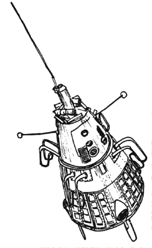
 Explorer 1 spacecraft
 Click   here for a full size version.
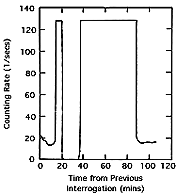
  Trace of counting rate
  of Explorer 3
Explorer 2 failed to orbit, but Explorer 3, launched March 26, was successful, and it did carry a tape recorder. Its trace of the number of counts was normal at low altitudes, then it rose rapidly to fill the transmittable limit of 128, but at the highest level it fell to zero. Laboratory experiments with similar counters confirmed that this was characteristic of extremely high counting rates, when the counter discharged so frequently that it could not properly recover between counts, yielding pulses too small to trigger the counting circuit.

Sputnik III, carrying more elaborate scientific instruments, was launched May 12 and confirmed the discovery. It was later realized that Sputnik II had also detected the belt at the highest part of its orbit, but that occured above Australia, where the USSR did not track it. The Australians did get the signal, but the USSR would not reveal to them the broadcast code. Further studies were conducted by Explorer 4 later that year (trapped radiation, history) and of course, by many spacecraft ever since.


Exploring Further

A web site with a picture of the Explorer-1 rocket and with links.

For more on the story of Explorer 1 and Sputnik, click here.

Click here for a web page devoted to James Van Allen, and here for his autobiography.

Sputnik 3

Next Stop: #12.  The Radiation Belts

----------------------------------------

#11a.     The Geiger Counter

As noted in the section on plasmas, gases conduct electricity only when some of their atoms are ionized, i.e. are split up into free electrons and ions. Fast electrons and ions emitted by radioactive materials do ionize atoms with which they collide, and Hans Geiger, an associate of Rutherford (ions, history) used this property to invent a sensitive detector for such particles.

A Geiger Counter
A "Geiger counter" usually contains a metal tube with a thin metal wire along its middle, the space in between them sealed off and filled with a suitable gas, and with the wire at about +1000 volts relative to the tube.

An ion or electron penetrating the tube (or an electron knocked out of the wall by X-rays or gamma rays) tears electrons off atoms in the gas, and because of the high positive voltage of the central wire, those electrons are then attracted to it. In doing so they gain energy, collide with atoms and release more electrons, until the process snowballs into an "avalanche" which produces an easily detectable pulse of current. With a suitable filling gas, the flow of electricity stops by itself, or else the electrical circuitry can help stop it.

The instrument was called a "counter" because every particle passing it produced an identical pulse, allowing particles to be counted (usually electronically) but not telling anything about their identity or energy (except that they must have sufficient energy to penetrate the walls of the counter). Van Allen's counters were made of thin metal, with insulating plugs at the ends.

----------------------------------------

#12.     The Radiation Belts

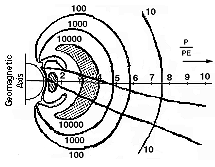
The Earth actually has two radiation belts of different origins. The inner belt, the one discovered by Van Allen's Geiger counter, occupies a compact region above the equator (see drawing, which also includes the trajectories of two space probes) and is a by-product of cosmic radiation. It is populated by protons of energies in the 10-100 Mev range, which readily penetrate spacecraft and which can, on prolonged exposure, damage instruments and be a hazard to astronauts. Both manned and unmanned spaceflights tend to stay out of this region.

  Cross-section of the two radiation
  belts, together with the orbits of
  Pioneers 3 and 4 which contributed
  early observations of them.
The outer radiation belt is nowadays seen as part of the plasma trapped in the magnetosphere. The name "radiation belt" is usually applied to the more energetic part of that plasma population, e.g. ions of about 1 Mev of energy (see energy units). The more numerous lower-energy particles are known as the "ring current", since they carry the current responsible for magnetic storms. Most of the ring current energy resides in the ions (typically, with 0.05 MeV) but energetic electrons can also be found.

Next Stop: #12H.  The Radiation Belts--History

----------------------------------------

#12a.     The Inner Radiation Belt

The inner radiation belt, discovered by Explorers 1 and 3, owes its existence to the extraordinary stability of trapped orbits near the Earth. It is a by-product of the cosmic radiation, which by itself has a rather low intensity: the amount of energy received by Earth from cosmic rays is comparable to what it receives from starlight. Only by accumulating particles over the span of years does the inner belt reach its high intensity.

Cosmic rays are fast positive ions, bombarding Earth from all directions, probably filling our entire galaxy. Though their numbers are small, the energy of each particle is quite high, so that when these ions smash into nuclei of atmospheric gases, fragments go flying off in different directions, some of them short-lived particles created by the collision. Most such fragments are absorbed by the atmosphere or by the ground, but a few are also splattered upwards, out of the atmosphere and into space.

If these are electrically charged, e.g. electrons or ions, they will often end up trapped by the Earth's magnetic field. None of these however lasts very long, since trapped orbits which rise from the atmosphere must sooner or later enter the atmosphere again.

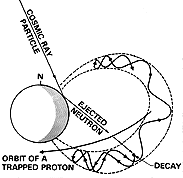
Some of the fragments are however neutrons, particles similar to protons but without the electric charge; neutrons make up about half the weight of a typical atomic nucleus. Having no electric charge, neutrons are not affected by the Earth's magnetic field, and moving far too fast for gravity to hold them back, they usually escape into space.

The free neutron is however radioactive: within about 10 minutes it breaks up into a proton, which captures most of the energy, an electron and a massless neutrino. Ten minutes is a fairly long time for a fast particle, time enough for many neutrons to get halfway to Mars. However, decay times are spread out statistically, and while 10 minutes is the average, a few neutrons decay quite soon, while still inside the Earth's magnetic field. The energetic protons which then materialize are grabbed by the Earth's magnetic field, often on trapped orbits which do not return to the atmosphere, in which the proton can stay trapped for a rather long time. That, it is believed, is how the inner belt arises.

----------------------------------------

#12b.     The Outer Radiation Belt

The space probes Pioneer 3 and 4 detected a wide belt of trapped particles beyond the inner belt. The intensity contours drawn here (together with the trajectories of the probes through space) were derived from their observations and are banana-shaped, because they follow magnetic field lines to which the particles are attached. We now know that outer-belt ions and electrons probably come from the long "magnetic tail" of stretched field lines on the night side of the magnetosphere.

The Two Radiation Belts
Now and then a violent outburst, known as a magnetic storm, drives tail plasma earthward, into the near-Earth magnetosphere. Electric fields (voltage differences) are essential to this process, to help tail particles break into trapped orbits and to drive them to higher energies. When the outburst ends and the electric field dies away, the particles find themselves locked in trapped orbits of the ring current and the outer radiation belt. Lesser outbursts, known as magnetospheric substorms, occur quite frequently.

Whereas the inner belt is marked by great stability, the ring current and outer belt constantly change. Sooner or later the particles are lost, e.g. by collision with the rarefied gas of the outermost atmosphere, and on the other hand, new ones are frequently injected from the tail. The electric fields which inject the new particles can also draw oxygen ions upwards from the ionosphere, and the ring current contains such ions, typically a few percent of the total, more during magnetic storms.


Authors and Curators:
  • David P. Stern - NASA/GSFC Code 695 (u5dps@lepvax.gsfc.nasa.gov)
  • Mauricio Peredo - Raytheon STX Corporation (peredo@istp1.gsfc.nasa.gov)

  • This joined-up file created 9 June 2001