#26.     The Polar Caps

    Plasma phenomena occuring at one place in the magnetosphere also affect other locations This linkage is most pronounced between points that share the same field line, since field lines guide the motion of ions and electrons.

    In both a dipole field and the actual magnetosphere, the field lines that extend to the greatest distances are those which begin or end near the magnetic poles. It follows that the places on Earth most sensitive to distant magnetic effects are the "polar caps", the regions around the magnetic poles. A good example is the polar aurora.

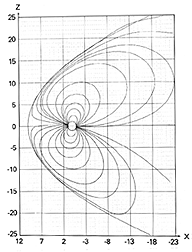
    If we were to trace back the field lines on which aurora appears (especially in substorms), we would probably arrive at the thick plasma sheet (outermost 3 red lines on the right side of the drawing) extending down the tail of the magnetosphere. Although that is where the process originates, the final energization of auroral electrons (as will be explained elsewhere) often happens quite close to Earth.

The Auroral Oval

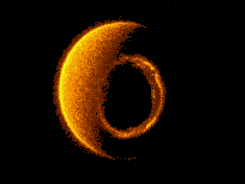
Cameras aboard satellites can look down at the aurora and snap its instantaneous picture at some given moment. What they see is a roughly circular strip, centered a little nightward of the magnetic pole, known as the auroral oval. During large magnetic storms the oval grows in size and may even reach the population centers of Europe and America, giving people there a rare opportunity to watch auroras from their own backyards.

The narrow auroral oval gives the instantaneous shape of the aurora. The "auroral zone" plotted by Loomis and by Fritz is much more smeared out, because it is the long term statistical average of many aurora observations. During some of them the oval is large, during others it is small, and it can also be displaced towards midnight and in other ways, all of which add up to produce a broad band.


Inside the Oval -- the Polar Rain

Field lines starting from points of the dark region inside the auroral oval, which includes the magnetic pole, extend to even greater distances. Early researchers, who believed auroral electrons came from the Sun (see history) could not understand why the aurora was absent from the vicinity of the magnetic pole itself. From satellite data we now know that field lines inside the oval extend to the "tail lobes," the twin bundles of field lines that extend down the Earth's magnetic tail (blue lines in the figure on top). Ultimately they probably lead into the solar wind, somewhere far on the nightside of the Earth. But the wind there is flowing rapidly away from Earth and its ions are not likely to reverse their direction and head upstream, back towards the Earth. Hence one expects very little plasma to come from that direction.

Yet something does flow earthwards on those field lines, a thin "polar rain" of fast electrons, with energies around 500 electron volts (ev). Solar wind protons have about 1000 ev each, but the electrons which move along with them, being about 2000 times lighter, also have a much smaller average energy. Electrons of 500 ev are a completely different population, easily able to outrace the solar wind and follow field lines in any direction. They are too few to produce a visible aurora, but instruments aboard satellites readily observe them. They provide the best evidence that the tail lobes are indeed connected to the solar wind.

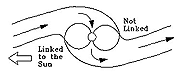
All magnetic field lines have a direction, which is why they are labeled by arrows--out of the southern polar cap, and into the northern one. Similarly, interplanetary field lines also have their directions. For about half the time, typically a week at a stretch, they may point away from the Sun, and the rest of the time, for comparable periods, they point towards it (in addition they are twisted by the Sun's rotation and by other factors).

  Schematic view of the way
  polar field lines are linked
  to the IMF and to the Sun
When they point away, they can only connect to the northern polar cap (drawing), while the bundle of lines coming out of the southern cap by necessity heads into the outer solar system. When the interplanetary field points towards the Sun, the opposite holds and it is exclusively the southern polar cap which connects to the Sun.

In 1976 it was discovered that when the interplanetary field lines pointed away from the Sun, the polar rain was much more intense in the northern cap then in the southern one, while when they pointed towards the Sun, the southern cap received the bigger share. Clearly, those electrons must have come from the Sun, and favored the pole with the direct sunward connection. It was also evident that the interplanetary field lines were somehow linked through the tail lobes to the appropriate polar caps, although how and where that connection is made is still not known for sure.

Next Stop: #26H.  Polar Cap--History


#26H.     Polar Cap -- History

The aurora is only seen in polar or near-polar regions. Why? Starting about 1895, the physicist Kristian Birkeland, in Norway, tried to answer this question experimentally.

In experiments begun around 1900, he put in a glass tank a small spherical magnet that modeled the Earth, which he named, like William Gilbert before him, terrella or "little Earth." Elsewhere in the tank he mounted an "electron gun" like the one found in TV picture tubes--a hot wire emitting electrons, and plates charged to positive voltages to pull them out and speed them on their way.


Birkeland believed that auroral electrons came from the Sun, and the electron gun, aimed at the terrella, represented that source. The air in the tank was then pumped out (as well as one could do so 100 years ago) and Birkeland was gratified to see that the electron beam indeed converged towards the polar regions of the terrella and avoided the equator. One of those experiments was recently restored to operating conditions and may be seen at the Auroral Observatory in Tromsø, Norway. For an article about that restoration, see here.

There remained one puzzle. Polar explorers had reported that the aurora was extremely rare near the magnetic poles themselves. Why? A few of Birkeland's experiments indeed produced a ring of light with a dark center, but in general he only got a polar patch of light, covering the magnetic poles of the terrella. Birkeland's younger friend, the mathematician Carl Stoermer, analyzed the motion of the electrons mathematically and even computed many of their orbits, a tough task in the pre-computer days around 1907-10. He found no compelling reason why electrons entering the field from far away would avoid the poles.

Stoermer died in 1957, still frustrated by this problem. The answer only came when satellites began probing the distant magnetosphere. They showed conclusively that the aurora did not in general come from the Sun or from distant space, but originated in the Earth's own magnetosphere. On the other hand, the electrons of the polar rain, which apparently did come from the Sun, were indeed found in patches surrounding the magnetic poles, exactly like the patches of light Birkeland observed on his terrella.

Further reading:

"A Brief History of Magnetospheric Physics before the Spaceflight Era," Reviews of Geophysics, 27, 103-114, 1989.

Next Stop: #27.  Auroral Imaging


#27.     Auroral Images

While the aurora is plainly visible to the eye, it changes constantly. A camera is therefore a useful tool in studying its features. For instance, how high up is the aurora? In principle, two observers on the ground can tell, by comparing the position of the same auroral arc against the background stars. In practice, only photographs snapped at exactly the same instant give satisfactory accuracy. The method was pioneered by Martin Brendel in 1892 and was greatly expanded by Carl Stoermer around 1910; it turned out that auroras occured most frequently around 100 km (60 miles), though much higher auroras (usually red) were also sometimes seen
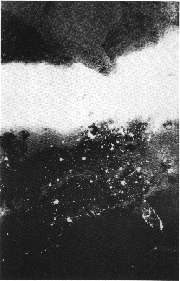
During the International Geophysical Year 1957-8, "all-sky cameras" were devised to record the entire aurora, horizon to horizon, by photographing its reflection (rather distorted!) from a curved mirror. But the best view is still from space. Starting in 1968, military satellites of the DMSP series scanned the land below them, their sensor sweeping again and again from far left to far right, perpendicular to their orbit. As the minutes passed, the scanned strips added up to full images, which often included auroral arcs.

The picture on the right is an example of such an image, showing the bright aurora of the great magnetic storm of 14 March, 1989 (for a web document containing two articles on that storm, click here). The display stretches across Canada; just below it, in the middle of the picture, are the lights of Chicago, next to Lake Michigan. Other US cities are also visible, Florida is outlined and so is Hudson Bay, near the top of the picture.

Scientific imagers in space

The Canadian scientific satellite Isis-2 (1971) carried an auroral imaging camera and discovered the diffuse aurora, a broad ribbon around the auroral oval, too spread-out to be noticed from the ground. This aurora is probably formed by electrons which leak out of the ends of field lines threading the plasma sheet.

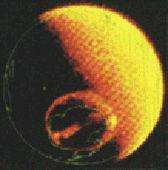
More comprehensive observations of the aurora from above were carried out (1981 - 1987) by the Dynamics Explorer 1 (DE-1) satellite which moved in an elongated polar orbit rising to 4.65 RE. Several modes of operation were used; some pictures were taken in the greenish oxygen "line" (emitted at the precise wavelength of 5577 angstrom) which usually dominates the aurora's appearance from the ground, but many used the ultra-violet. The typical time resolution was 2-12 minutes, enough to resolve the phases of a substorm but not finer details.

Later auroral imagers included Sweden's "Viking" (in 1986) and "Freja." Currently, NASA's Polar (1996) collects images of the polar aurora using three cameras--in visible light (sometimes as frequently as 12 seconds apart), in ultra-violet and in x-rays.

Theta Aurora

DE also studied a special class of auroras (mapped earlier by Isis 2), aligned not with the auroral oval but sticking out from it, into the dark interior around the magnetic pole, generally aligned with the sunward direction. They occur at quieter times, away from substorms. The DE imaging camera found that at times such arcs extended completely across the oval, bridging the dark space from the night side to the day side. The global pattern then resembled the Greek letter theta, a circle with a bar across its middle, and this form was therefore named the "theta aurora." No good explanation exists as yet for either sunward arcs or the theta aurora.

The speed of Auroral motions

While satellite imagers view the aurora from above, TV cameras are nowadays used to watch it from below, a narrower view than the one from space but a more detailed one. To the eye the aurora appears quite sluggish, its rays slowly brightening and fading. However, the slowness is not in the aurora but in the light emission process of the green line of oxygen, which usually provides most of the auroral light seen from the ground. An oxygen atom energized by the collision of an auroral electron may not emit this light promptly, but only after a delay, typically close to a second.

Sensitive TV cameras can filter out that light and view the aurora in other emissions, fainter but responding much more promptly. The resulting pictures show more details and change quite rapidly.

Next Stop: #28.  Auroral Acceleration


<

#28.     The Acceleration of Auroral Electrons

The "ring of fire" seen by satellite cameras around the polar caps (picture below) is probably created by electrons leaking from the tail's plasma sheet, whose magnetic field lines form a somewhat imperfect trap.

Auroral oval from space

    Observers on the ground, however, don't see that"diffuse aurora," which is dim and lacks sharp outlines. The bright arcs of the "discrete aurora" which they do see--ribbons in the sky, often shimmering, folding, and constantly changing--have a different origin. Satellites flying through the electon beams which create such arcs see evidence that their electrons have actually been accelerated. It is as if a giant "electron gun" existed somewhere up in space, like the one found in TV picture tubes, and was shooting electrons down field lines.

Some enterprising scientists (e.g. the Russian-French "Araks" experiment, and "Project Echo" of the University of Minnesota) did in fact mount electron guns on high altitude rockets, and used them to create patches of "artificial aurora" in the high atmosphere. Artificial aurora was also created by electrons released from high-altitude nuclear tests between 1958 and 1962, visible in Hawaii, Samoa and off the Azores Islands, places too close to the equator for natural aurora. Such tests are now banned by international agreement.

Trapped O+ ions

Clear evidence for the acceleration of the natural aurora came in 1976 from the US Air Force satellite S3-3. A voltage which accelerates negative electrons downwards will also accelerate positive ions upwards. When instruments aboard S3-3 showed positive O+ ions of oxygen shooting upwards in the auroral zone, scientists realized that the "electron gun" (or at least part of it) must have been at such times below the spacecraft. O+ ions are the main ion type in the ionosphere (peaking around 200 km or 120 miles), but since 1971 they had also been observed in the ring current, at much, much higher energies than those of O+ in the ionosphere. S3-3 had just discovered the link between these two ion populations.

The S3-3 satellite was not in a particularly high orbit, and the O+ ions were typically observed at altitudes of the order of one Earth radius (about 6000 km or 4000 miles). If the auroral "electron gun" was below that altitude, it was indeed surprisingly close to Earth, not in the distant magnetotail where many scientists were looking for it.

Voltage drops along magnetic field lines

One possible explanation involves the close association between auroral arcs and electric currents which flow along field lines between the ionosphere and distant space (Birkeland currents). Such currents are generally carried by electrons, which being negative, travel in a direction opposite from that of the electric current. When the current flows downward, the electrons move up, drawn from the ionosphere, where they are quite plentiful. Magnetic field lines diverge away from each other in that direction, the field gets weaker with distance and it is quite easy for electons to move out.

Not so when the current flows upwards--and since all currents flow in closed circuit, if somewhere the current flows downwards, somewhere else it must flow upwards. In that case electrons move down, from space towards the Earth. That is the direction in which field lines converge and the magnetic field grows stronger; and as was discussed in the explanation of particle trapping, electrons tend to be reflected back from such regions. That produces an extra resistance to the flow of current.

Unlike the ring current, carried by plasma which is just "coasting" through space, electric currents which flow into and out of the ionosphere require a driving voltage and a continuous input of energy. After all, part of their circuit lies in the ionosphere, which (like copper wire and seawater) resists the flow of electricity and will not allow a current to flow unless the two above requirements are met.

The region of converging field lines further hampers the upflowing currents, by the "mirror force", and nature's way of overcoming this is to allocate part of the driving voltage--typically, 5-15,000 volts--to help drive the current through the "bottleneck" of its circuit. That is the voltage which accelerates auroral electrons (and in the process, also some O+ ions), and it was shown in the early 1960s by Hannes Alfvén, Swedish Nobel prize winner, and by Alfvén's associate Hans Persson, that such voltages were expected to be concentrated in the near-Earth parts of magnetic field lines.

That, however, may not be the entire story. Other acceleration processes are also at work, as evidenced by oxygen ions which seem to have been accelerated not along field lines but perpendicular to them, boosting the energy with which they circle their guiding lines. A variety of plasma waves associated with the aurora may be involved here.

Update--December 1998

Recently NASA's FAST satellite (Fast Auroral Snapshot Explorer) uncovered some details of the process. FAST was launched in August 1996 and (as its name implied) was designed to resolve rapid variations as it flew through auroral arcs. Both upward and downward currents were found to accelerate electrons--upward currents shot electrons of several KeV down into the atmosphere (the process discussed above), but downward currents also accelerated electrons, upwards, by several hundereds of electron volts. In addition to "beams" of accelerated ions, both directions also observed "conics", apparently accelerated by wave processes.

Next Stop: #29.  Low Polar Orbit


#28a.     The Direction Assigned to Electric Currents

    The choice of which type of electricity is called "positive" and which "negative" was made around 1750 by Ben Franklin, early American scientist and man of many talents (the stamp on the left commemorates his role as first US postmaster--and colonial postmaster before that). Franklin studied static electricity, produced by rubbing glass, amber, sulfur etc. with fur or dry cloth. Among his many discoveries was proof that lightning was a discharge of electricity, by the foolhardy experiment of flying a kite in a thunderstorm. The kite string produced large sparks but luckily no lightning, which could have killed Franklin.

Franklin knew of two types of electric charge, depending on the material one rubbed. It is not known whether he tossed a coin before deciding to call the kind produced by rubing glass "positive" and the other "resinous" type "negative" (rather than the other way around), but he might just as well have. Later, when electric batteries were discovered, scientists naturally assigned the direction of the flow of current to be from (+) to (-). A century after that electrons were discovered and it was suddenly realized that often the electrons were the ones that carried the current, moving in exactly the opposite direction. However, it was much too late to change Franklin's naming convention


#29.     Polar Orbiting Satellites

Different types of satellite orbits have different uses: while the synchronous orbit is best for communication satellites, Lagrangian point orbits help monitor the solar wind before it reaches Earth. A low altitude polar orbit is widely used for monitoring the Earth because each day, as the Earth rotates below it, the entire surface is covered. Typically, a satellite in such an orbit moves in a near-circle about 1000 km (600 miles) above ground (some go lower but don't last as long, because of air friction) and each orbit takes about 100 minutes. Many spacecraft use such orbits, e.g. the US Air Force surveillance satellites of the DMSP series, or the series of French Earth-resources spacecraft SPOT.

The space shuttle avoids polar orbits, because flying through the aurora exposes astronauts to radiation and creates other problems. But for studying the aurora, Birkeland currents, polar rain and other phenomena related to the distant magnetosphere, such orbits are very useful. For instance, although the DMSP spacecraft (above) were designed for military needs, scientists have also equipped them with magnetometers, particle detectors and other instruments, which have provided a great amount of scientific information.

In fact, although the DMSP mission was originally conceived as a project of the US Air Force, its scientific usefulness has been so widely recognized, that its follow-up will be a joint mission of the USAF, NOAA (National Oceanic and Atmospheric Administration, successor to the US Weather Bureau) and NASA. Known as the National Polar-orbiting Operational Environmental Satellite System or NPOESS ("en-poss") for short, the satellites of that mission, to be launched in the first decade of the 21st century, will carry a sophisticated complement of scientific instruments.

Sun-synchronous Orbits

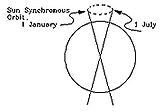
The Earth is not an exact sphere but bulges slightly at its equator. Any orbit passing exactly above the geographic poles is symmetrically affected by the bulge and its plane stays fixed relative to the stars.

Relative to the Sun, however, the orbital plane will slowly rotate. The reason is that the Earth itself orbits the Sun, so that the Sun's position in the sky, relative to the distant stars, slowly rotates around the Earth, one circuit per year. (The 12 constellations through which the Sun passes on that journey were named by the ancients and are known as the zodiac.) If the orbital plane of the polar satellite points at the Sun now, in three months' time the Sun's motion across the sky would make that plane perpendicular to the Sun's direction.

    An inclined orbit, whose northermost point is not the north pole but falls short by (say) 1000 km, will be affected asymmetrically by the Earth's bulge, and as a result its orbital plane would slowly rotate around the Earth's axis. With a suitable inclination, about 8 degrees off the polar orbit, that motion matches the slow motion of the Sun across the sky. If the satellite then starts near a noon-midnight orbit, it will always pass near noon and near midnight. A noon-midnight "Sun-synchronous" orbit was actually used by some DMSP satellites.

A different choice was made for MAGSAT, orbited 1979-80 to survey the Earth's own magnetic field near its surface. Magnetic fields from the magnetosphere are a disturbing factor in such a mission, a factor that strongly depends on the orientation of the orbit relative to the Sun's direction. By placing the satellite in a sun-synchronous orbit near the dawn-dusk plane (90 degrees to the noon-midnight plane described earlier), not only was the interference kept small, but because the orbit's orientation relative to the Sun did not change, the disturbance also stayed more or less the same throughout the mission.

On the other hand, the Dynamics Explorer (DE) mission of 1981 used two polar spacecraft, one in a low orbit to intercept the aurora (among other things) and a second one in an elongated orbit to observe auroral acceleration and also to take pictures of the entire auroral oval from a distance. To ensure the best chance for the two spacecraft to intercept the same auroral electron beam at different altitudes, it was decided that both orbits would always share the same plane. They were therefore made to pass over the geographical poles: with any other choice the Earth's bulge would have rotated the planes at different rates and they would have soon drifted apart.

Next Stop: #30.  Magnetic Storms


#30.     Magnetic Storms

The term "magnetic storm," meaning a world-wide magnetic disturbance, was coined by Alexander von Humboldt (1769-1859). A naturalist who gained attention by exploring the jungles of Venezuela, Humboldt devoted much of his life to the promotion of science. He produced five volumes of "Kosmos" (starting the modern usage of that term), an encyclopaedic account covering the broad spectrum of the sciences. It was "Kosmos" which brought to the world's attention the discovery of the sunspot cycle by Heinrich Schwabe.

After journeying through Siberia, Humboldt convinced the Czar to set up a network of magnetic observatories across the Russian lands, and additional stations were established throughout the British Empire, from Toronto to Tasmania. This network clearly showed that magnetic storms were essentially identical all over the world: a steep decrease of the field over 12-24 hours, followed by a gradual recovery which lasted 1-4 days. The change in the magnetic field was small, in modern units some 50-300 nT (nanotesla) out of a total intensity of 30-60,000 nT, but its world-wide scale suggested that something quite big was happening out in space.

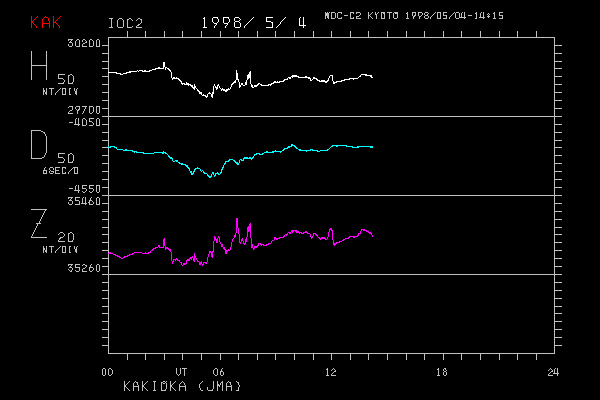
The image below is from the magnetic storm of May 5, 1998, as observed by the Kakioka observatory in Japan. The top trace is the one characterizing the storm and the drop is close to 3 divisions or about 130 nT, occuring over about 3 hours. The same observatory can also also provide you with today's magnetic record.


The disturbing field pointed southward, suggesting that it came from a "ring current" circling the Earth, and we now know that such a current does exist, carried by the outer radiation belt. In magnetic storms the outer belt becomes much more intense, reinforced by protons coming from the tail, as well as by O+ ions from the ionosphere.

The Geocorona

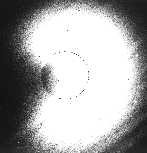
Most of the trapped ions added in magnetic storms, especially those with lower energies, disappear again within a few days. They are usually removed by collisions with the outermost part of the Earth's atmosphere, a huge cloud of hydrogen known as the geocorona extending to a distance of 4-5 Earth radii. It was photographed in 1972 (picture below) by Apollo astronauts on the Moon, using an ultraviolet-light camera developed by George Carruthers and his team at the US Naval Observatory.

    The loss process involves so-called charge exchange collisions.

    The neutral hydrogen atoms of the geocorona move quite slowly and have much less energy than ring current ions (if they had more, the Earth's gravity would not hold them!). A collision often ends up transferring an electron from the hydrogen atom to the ring-current ion, without much change in the particles' energies.

The hydrogen atom, having lost an electron, becomes an ion (proton), and because of its low energy, contributes very little to the ring current. On the other hand, the ring current ion which has gained an electron is now neutralized, becoming a fast neutral atom with a great deal of energy. Since the Earth's magnetic field can only trap charged particles, the fast atom usually disappears quickly into distant space. In this way the "charge exchange" process gradually removes newly added particles from the ring current. Only the more energetic ones remain, since their probability of undergoing charge exchange is much lower.

This process has an unusual application, allowing the ring current to observed remotely, a bit like the way astronomers observe distant stars through their telescopes. Astronomers use light, which moves in straight lines. Similarly, if one could build a camera that used energetic neutral atoms (ENA) created in the ring current by charge exchange, it might be able to picture the ring current, too, since ENAs also move along straight lines.

The "Image" mission using such a camera is in fact scheduled for launch in the year 2000. Technically this is a rather difficult feat, because the number of ENAs coming from the ring current, especially outside magnetic storms, is rather small. A pilot experiment of this type ran for five weeks aboard the Swedish satellite Astrid, launched in December 1994, and produced some very simple ENA images.

Storms and Substorms

What creates a magnetic storm?

Substorms have now been studied for many years, from space and from the ground. Their details vary from one event to the next, just as thunderstorms in the atmosphere never seem alike, but many scientists have nevertheless concluded that they are a fundamental mode of energy release and of particle acceleration.

Magnetic storms usually have a well-defined trigger--often the arrival of an interplanetary shock. Their main effect on the magnetosphere is the injection of many energetic ions and electrons from the tail, causing the ring current to grow significantly. Yet substorms also inject such particles, as was shown in 1971 by the instruments aboard the synchronous ATS-1, an experimental communication satellite with a "piggyback" scientific payload. Many other satellites have studied substorm injections since then, confirming that substorms also injected ions and electrons into the ring current--only, not as many, penetrating less far and with lower average energy.

Apart from its sudden initiation, is a magnetic storm primarily a series of large and intense substorms? That was apparently the view of Sydney Chapman (1888-1970), distinguished researcher of magnetic storms, who introduced the term "substorm" to suggest precisely that idea. Chapman noted in 1963 that the same storms which at near-equator observatories, e.g. in Hawaii, followed simple curves of growth and decay, in Alaska seemed to consist of a number of distinct "sub-storms."

Substorms however exist at other times as well (as S. Akasofu, Chapman's student, discovered soon afterwards). They do not need much of a stimulus: during times of southward interplanetary field, the tail seems to quickly reach the brink of instability, and small changes in the solar wind can then precipitate a substorm. Although magnetic storms seem to come from more powerful sources, such as the arrival of interplanetary shocks, they too seem to require (usually) a southward IMF. A strong shock arriving with a northward IMF may shake the magnetosphere, but not to the point of creating a storm. Thus much still remains to be clarified.

M-regions and Coronal Holes

The connection between magnetic storms and sunspots was well established around the turn of the century. When large active sunspots were visible, big magnetic storms were much more likely. In today's terminology one might say that the intense field of sunspots was likely to lead to sudden releases of magnetic energy, manifested by flares and coronal mass ejections, and those in their turn sent out fast interplanetary plasma clouds whose shock fronts caused magnetic storms.

The relation between sunspots and smaller magnetic storms, however, seemed less firm. In 1904 E.W. Maunder of the Royal Observatory in Greenwich, England, proposed that many such storms belonged to an entirely different class, tending to recur at intervals of 27 days, the Sun's rotation period. It was as if something on the rotating Sun was beaming those storms at us. However, attempts to identify those regions on the Sun suggested that they were bland and featureless, containing no sunspots. Astronomers named them "M regions" (M for magnetic storms), and for a long time no one had a clue about what set them apart.

Space observations finally pointed the way. In 1962 the space probe Mariner 2, on its way to Venus, noted that the solar wind contained recurrent fast streams, whose sources appeared to rotate with the Sun. The arrival of such streams was found to trigger moderate storms of the kind studied by Maunder, but their cause was still unclear.

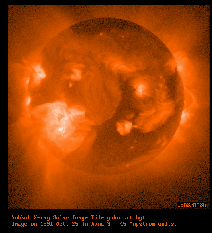
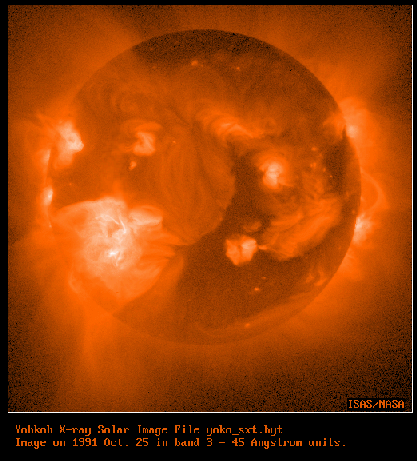
A decade later, in 1973, astronauts aboard the space station Skylab observed the Sun in soft X-rays. Such pictures, like the one on the right which was taken by the Japanese satellite Yohkoh, highlight the hot spots of the corona:


Click here for a full size version of this image.

Bright X-ray regions in the corona were often associated with sunspots, which (it seemed) pumped extra energy into the regions above them. In contrast, the elusive "M-regions" turned out to be the dark areas in-between, named "coronal holes." Apparently, the arches and loops of magnetic field lines produced in sunspots trapped and held back solar plasma, hindering it from flowing away as solar wind. In "coronal holes", on the other hand, the magnetic field was weaker and its field lines stuck out straight into space, providing an easy route along which solar wind could flow. Thus although such regions were cooler than their neighbors, they were better sources of solar wind. The polar caps of the Sun, away from the sunspot belts, form two very large "coronal holes", and the solar wind emanating from them was expected to be fast and steady, a prediction confirmed by Ulysses. The "holes" which produce fast solar wind streams at Earth are generally extensions of the polar ones.

Next Stop: #31.  Space Weather


Birth of a Radiation Belt

(text of an article by D.P. Stern)

The recent impacts on Jupiter by the fragments of comet Shoemaker-Levy are a sobering reminder of the violent forces that exists in space, released now and then in spectacular fashion. A violent event of a different type occurred in March 1991, when a powerful interplanetary shock wave hit the Earth's magnetic field and created a new radiation belt. Nothing like that had happened since July 1962, when the US Air Force exploded a hydrogen bomb above the atmosphere, creating a belt of trapped radiation which lasted five years and caused the demise of three spacecraft.

At 03:42 Greenwich time on March 24, 1991, the population of high-energy electrons and protons trapped in the Earth's magnetic field suddenly received huge reinforcements. The new belt was so intense that it knocked out (within a few days) the MARECS-1 communication satellite, and NOAA's weather satellite GOES-7 was also seriously degraded.

The Solar Wind

This time the culprit was no H-bomb but the old familiar Sun. The Sun sends out life-giving light and heat, but it also has its violent outbursts, especially around the peak of its 11-year sunspot cycle. In addition to sunlight, the Sun also sends out the solar wind, a continuous flow of very hot, very rarefied gas, blowing from the Sun's topmost atmosphere, the million-degree solar corona. That gas is so hot that its atoms are broken apart, turning it into a "soup" of free-floating negative electrons and positive ions (mainly protons). In scientific terms, the gas becomes an electrically conducting "plasma," and as it moves outward at some 250 miles/second, it is too rarefied and too hot for its electrically charged particles to recombine again.

This solar wind fills the entire solar system, well beyond the outermost planets, but it does not reach the Earth, because we are shielded by our planet's magnetic field. Instead it flows around the magnetic obstacle, the way a creek will flow around a rock in its path. A shielded cavity is formed, the "magnetosphere" surrounding the Earth; the closest the solar wind penetrates towards the Earth is about 10-11 RE (Earth radii), or some 40,000 miles, on the side of the cavity facing the Sun.

Interplanetary Plasma Clouds

But the flow of the solar wind is not always steady and peaceful: superposed on it now and then are violent outbursts on the Sun, causing huge expanding clouds preceded by sudden shock fronts. The outbursts seem to be associated with sunspots, strongly magnetic areas on the Sun whose number rises and falls in an 11 year cycle. Some of the magnetic energy associated with sunspots can apparently be released rather abruptly--how and why, we only dimly comprehend, and for that matter, we also have no good idea of what makes the corona so hot.

Besides expanding clouds, the Sun's outbursts also create great numbers of fast ions, enough to fill the inner solar system, each with an energy that can reach several million times that of solar wind particles; such particles behave very much like intense nuclear radiation, and are a danger to the lives of any astronauts who happen to be on their way to the moon or to Mars, outside the shield of the Earth's magnetosphere. Intense X-rays and radio waves are also emitted, coming from high energy electrons which did not manage to escape the Sun.

Until recently such radiation was credited to solar flares, bright spots that suddenly appeared in the Sun's high atmosphere near sunspots, supposedly signifying energy release in the corona. But in 1973 astronauts aboard the Skylab space station saw something new: huge bubbles of hot gas, expanding upwards much faster than the solar wind, fast enough to push shock waves ahead of them into interplanetary space. Such "coronal mass ejections" (CMEs) seemed closely related to the interplanetary shocks which now and then strike the magnetosphere. Each year a few such shocks are strong enough to push the magnetosphere's boundary past the synchronous orbit, at 6.6 RE, where communication satellites generally dwell. Recent opinion has been that CMEs, rather than flares, are more likely to be signs of sudden solar energy releases that affect the Earth.

The Event of 24 March, 1991

On March 23, 1991, a fairly significant flare erupted on the Sun, and hours later, energetic protons appeared in the Earth's vicinity. It took a day for the shock to arrive (ordinary solar wind takes four or five days), and it struck the magnetosphere on the afternoon side; later the shock also passed the space probe Ulysses, 2.5 times more distant from the Sun and on its way to study the region above the Sun's poles. Spacecraft data afterwards suggested the boundary might have been pushed back to a record depth, within 4 RE of the Earth's center, and that the impact also created a second shock wave inside the cavity, spreading throughout the magnetosphere.

The research spacecraft CRRES, operated by the US Air Force with NASA participation, was at that instant deep inside the radiation belt, at a distance of 2.55 RE. CRRES (pronounced "cress") stands for Combined Release and Radiation Effects Satellite, reflecting the spacecraft's multiple duties--to probe the radiation belt, as well as to release clouds of barium and lithium vapor, tracing motions of the magnetosphere the same way as a plume of smoke traces the motion of wind. CRRES was also a testbed for a variety of electronics circuits, to help engineers design electronics and microcomputers to perform reliably in space, even in the heart of the radiation belt.

The first thing CRRES saw was a torrent of highly energetic protons and electrons. The protons had energies above 20 Mev, twenty million electron volts, some 20,000 times the energy of the average proton in the solar wind. The electrons had about 15 Mev, and the energy of either type was quite sufficient to penetrate a spaceship and cause damage. In the concluding words of a scientific study of this event, "it is fortunate that present-day space missions do not spend much time in this region of the Earth's magnetosphere." On that particular day and for a long time afterwards, that region was indeed a hot place to be in.

The Acceleration of Energetic Particles

Faced with such phenomena, the engineer naturally worries about the safety of payloads and passengers. The scientist, however, stands amazed: how can particles gain such high energy, within no more than tens of seconds? In the laboratory particles can be energized by accelerators, cleverly designed machines which carefully channel their particles, but in nature conditions vary all the time and follow no precise rules.

Yet we have abundant evidence that ions and electrons in space are indeed accelerated to high energies, all over the universe: in flares and CMEs near the Sun, in elusive "substorms" of the magnetosphere, in the radiation belts of Jupiter and other magnetized planets and in the unknown sources of cosmic radiation, the perpetual drizzle of extremely energetic ions which bombards the Earth. On March 24, 1991, it happened right in front of our eyes, as if by a conjuring trick. But how?

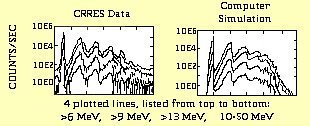
Some evidence came from the particles themselves. Energetic ions and electrons trapped by the Earth's magnetic field drift around the equator--positive protons clockwise (viewed from north), negative electrons counter-clockwise. The sudden burst of electrons intercepted by CRRES quickly ebbed again, suggesting it was caused by a compact cloud of electrons which soon drifted away.


CRRES observations (left) and a computer simulation (right) of the sudden injection of high energy electrons on March 24, 1991. The horizontal axis measures time and the peaks are about 150 seconds apart.


The cloud came back several times after circling the Earth, at intervals of about 150 seconds. The length of the drift period told researchers that the electrons had about 15 Mev of energy, and the fact that the radiation peak stayed well-defined over at least four returns suggested that their spread of energies was very small. The higher the energy, the faster the drift, so that a cloud of electrons with widely differing energies is quickly dispersed as fast electrons overtake slow ones. That is what happened to bomb-produced electrons in 1962; the initial pulse (revealed by its radio signal) was sharp and well-defined, but when it returned after one circuit it was already spread-out like a pile of sand. The protons observed on March 24, 1991 also displayed such periodic "drift echoes" which stayed together for several returns but since their drift was faster (protons are heavier), the separation of the return pulses was smaller.

Explaining the Sudden Acceleration

Scientists then examined the shock wave itself, recorded by magnetic observatories around the globe through its associated magnetic pulse. At CRRES the shock was also accompanied by a strong electric field, a voltage spike. Wave phenomena in space generally combine both electric and magnetic fields, the former energize ions and electrons while the latter mainly steer them.

Dr. Xinlin Li of Dartmouth College in New Hampshire and his colleagues--Mary Hudson at Dartmouth, Ilan Roth, John Wygant and Mike Temerin at Berkeley, and Bernie Blake at the Aerospace Corporation--used a computer to model the path of the shock wave and to reconstruct the way it affected electrons already present in the magnetosphere. They selected a wide range of initial positions and energies, then calculated the tracks of more than 300,000 electrons, examining how each of them fared when the wave passed over it. The result resembled in many ways the way a surfer rides a wave. Electrons starting with unfavorable positions or energies gained little energy or even lost some; however a few lucky ones matched the speed of the advancing wave, rode the crest deep into the magnetosphere and gained much energy in the process. In their computer simulation Dr. Li and his colleagues managed to reproduce quite convincingly the initial pulse and two of the periodic "drift echoes."

Did this explain the way ions and electrons are accelerated in nature? Not completely, because the favored electrons already needed a hefty amount of energy to start with, close to 2 Mev. The abundant low-energy electrons in the magnetosphere gained very little energy: like pieces of driftwood bobbing in the surf, as the shock passed them their energy rose briefly and then went down again. Electrons of around 2 Mev indeed exist in the magnetosphere, and they seem to be the ones from which the new radiation was formed. But their origin has always been something of a mystery: some scientists have even speculated that they may have escaped from the intense radiation belt of the distant planet Jupiter.

The New Belt

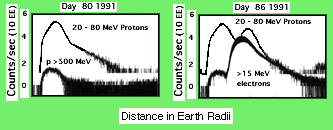
The passage of the shock also left Earth with a new long-lived belt of high-energy protons. Prior to March 1991 the main radiation hazard in near-Earth space was the intense inner radiation belt, a by-product of cosmic radiation. Traverses by CRRES after that date showed a second peak of comparable intensity, apparently composed like the inner belt of protons above 20 Mev. It was more distant than the natural inner belt, centered in the region where CRRES had made its initial observations. In hindsight, the spacecraft was just about ideally placed for observing the event.


(left) Before the event of March 24, 1991;
(right) Immediately afterwards. The horizontal axis measures distance from the Earth's center. The left edge is at the surface of the Earth (1 Earth radius = 1 RE), the peaks of the "old" inner belt (left panel) occur around 1.5 RE and the electron and ion peaks added by the new belt are at about 2.1-2.2 RE.


CRRES continued to observe the new belt for seven months, until the spacecraft's untimely demise (due to battery failure) on 12 October, 1991, by which time the new belt had diminished somewhat in intensity. Since then scientists have only managed to sample the belt's far fringes, crossed by low-flying satellites. In past decades the US always had one or more scientific spacecraft in an elongated orbit, cutting through all levels of the magnetosphere; but none was left after CRRES fell silent. For all we know, some of the belt's remnants may still be orbiting above our heads.


#31.     Space Weather

Why explore the magnetosphere? One compelling reason is that doing so helps us understand phenomena in the more distant universe, in particular the intricate web of plasma phenomena, magnetic fields and particle acceleration.

But there also exists a practical angle: in a world increasingly dependent on electricity and electronics, the "space weather" outside the atmosphere can have serious effects, in particular on human communications.

Currently more than 200 communication satellites circle the Earth in synchronous orbit. A large magnetic storm can greatly increase the number of fast ions and electrons which hit those satellites; such ions and electrons are similar to the ones emitted by radioactive substances and can create serious problems.

The simplest effect is an electric charge on the satellite, usually negative, raising its voltage to hundreds or even thousands of volts. Charging by itself has little effect on the satellite's operation, although on a scientific satellite it would seriously distort observations (if the satellite is charged to, say, -500 volts, electrons with less energy than 500 electron-volts are repelled and cannot be detected). However, if different parts of the satellite are charged to different voltages, the current between them can cause damage.

Particles with higher energy can permanently degrade solar cells. Also, high-energy particles can penetrate the circuitry and cause either damage or false signals which lead to unintended responses by the satellite. All these have occured in the past.

Another effect of magnetic storms (and to lesser extent, of substorms) is a greater intensity of the electric currents circulating between Earth and distant space. As already noted, these currents are associated with the polar aurora, and they flow from space into the auroral zone or the other way around. In big storms, not only is the magnetic disturbance more intense, but it also spreads further equatorwards, into more densely populated areas. For instance, in the picture on the right, taken from space during a storm in March 1989, aurora blankets the northern states of the US as well as southern Canada

This disturbance also induces extra currents in the wires of the electrical power grid, creating a temporary overload. Serious overloads of this type can trigger circuit breakers and thus cause widespread "power blackouts," and on occasion they have even destroyed power transformers.

For these reasons, conditions at the Sun, in interplanetary space and in the magnetosphere are closely watched. The Space Environment Center in Boulder, Colorado, maintained by of the National Oceanic and Atmospheric Administration (NOAA), has a Space Weather Operation facility which constantly tracks the "weather" in space.

This is done in several ways. NOAA satellites of the GOES series, in synchronous orbit, observe the local radiation environment and also monitor the Sun's x-rays, which come from the corona and increase at active times. Telescopes on Earth observe the Sun through special filters and in special wavelength (e.g. x-rays), all of which highlight active features. For a view of NOAA's "space weather report," click here; another such report, from the University of Michigan, is linked here.

In an interesting development, the recent SOHO spacecraft, currently at the L1 Lagrangian point, allows scientists to detect (by special processing of its images) coronal mass ejections, not just in a sideways view but even when they are headed straight for Earth. A CME noted in this way on January 6, 1997, arrived as predicted on the 10th-11th and caused a widespread disturbance. Another such event occured April 7-11, 1997.

Of course, the sideways view of CMEs contains additional information, and NASA's planned solar missions include STEREO (Solar Terrestrial Relations Observatory), with a pair of well-separated solar observatories, to get a stereoscopic view of such eruptions. One spacecraft would orbit near Earth, the other would be stationed elsewhere in the Earth's orbit around the Sun, capturing a sideways view of solar eruptions. So far there is unfortunately no sure way of predicting whether the direction of the magnetic field carried by an erupting solar plasma would slant northwards or southwards, an important factor in predicting "space weather." Closer to Earth, spacecraft near the L1 point such as SOHO and WIND, and since August 1997 also ACE, intercept shocks and plasma clouds up to one hour before their arrival at Earth and serve as early warning stations.

An obvious question is whether the high energy particles produced by such events constitute a hazard not just for spacecraft but also for astronauts. So far no astronauts have been seriously exposed, not even those on the Russian space station "Mir" whose inclined orbit extends to fairly high latitudes, closer to the auroral zone than the planned orbit of the International Space Station planned by NASA. Nothing in space can be guaranteed, however, and re-entry modules for quick escape into the protecting atmosphere have been studied.

Further links and articles:

Next Stop: 32.  Magnetospheres Other than Ours


#32.     Magnetospheres other than Ours

The Earth's own magnetic field is probably created in the Earth's core, believed to contain molten iron, by a "fluid dynamo". These are rather special conditions and scientists who studied the Earth's dynamo in the 1950s and 1960s must have wondered whether the Earth's planetary magnetism was unique.

We now know better: space probes have found that Jupiter, Saturn, Uranus and Neptune all have magnetic fields, as does tiny Mercury. The Moon has patches of magnetized rocks and might have had a field when those rocks formed long ago, abd Venus seems non-magnetic. Mars was a mystery until September 1997, when Mars Global Surveyor found it to be magnetized in patches, like the moon but several times more strongly.

  Jupiter
(bigger version)
The sources of other planetary fields seem quite different from the Earth's and one can only speculate about their origin. For instance, does the magnetism of Jupiter and Saturn originate in cores of metallic hydrogen, a form which can exist under the enormous pressures at their centers? And since Uranus and Neptune do not generate enough pressure for hydrogen to become metallic--are their internal currents carried by ions dissolved in water or methane ices?

The magnetization of Mercury, Mars and the Moon must belong to a different class (see "Mercury: the Forgotten Planet" by R.M.Nelson, Scientific American, November 1997, p. 56). In particular, the moon, and perhaps Mars, may contain permanently magnetized rocks, from lavas which poured out in the distant past, when the parent body was magnetized, and became weakly magnetized themselves (this process does happen on Earth). All this, though, is speculation: we really do not yet know

Jupiter

    Jupiter is the largest planet of the solar system and has the most powerful magnetic field, also the largest radiation belt; radio emissions from its belt were first detected by radio astronomers in 1955. Jupiter's magnetosphere was explored by the space probes Pioneer 10 and 11, Voyager 1 and 2, and Ulysses, and the space probe Galileo has been orbiting there since late 1995.

Jupiter's radiation belt is quite intense, and just one pass through its denser part by Pioneer 10 in 1973 was enough to cause some radiation damage, luckily rather minor.

Differences in Scale

The magnetospheres of the giant planets differ from the Earth's in at least four ways. First, they are much bigger, not only because the planetary magnets are stronger but also because the solar wind weakens as it moves away from the Sun and spreads out. Both of these factors cause the solar wind to be stopped further away from the planet than is the case with Earth.

The speed of the solar wind however remains the same, about 400 km/sec. As a result, the wind needs a much longer time to traverse the length of the magnetosphere.

With the Earth's magnetosphere, it takes the solar wind about one hour to advance from the "nose" to the distant tail regions where ISEE-3 and Geotail have probed it, some 200 RE downstream. During that one hour the Earth rotates by a rather small angle, 15 degrees, and if "open" field lines in the lobes connect it to the solar wind, those lines might become twisted by about 15 degrees.

If Jupiter's magnetosphere has the same proportions, the solar wind would need 2-3 days to cover the corresponding distance (equal to about half the Earth-Sun distance!), during which the planet might have rotated 5-7 times around its axis. One might therefore expect the lobes of Jupiter's magnetotail (and Saturn's, too) to be severely twisted, and the Galileo mission might be the first opportunity to examine this point. All other probes sent to Jupiter used the planet as a pivot to gain extra speed, the way "Wind" used the moon, and the orbits required for this maneuver kept them out of the lobes.

Satellites

Secondly, all these planets possess satellites and rings within their radiation belts (all four have rings, but only Saturn's ring is big enough to be easily seen from Earth). These absorb some of the trapped ions and electrons and produce dips in the profiles of the belts.

But they do more than that. Saturn seems to have an inner belt like the Earth's, and calculations suggest it is produced by cosmic ray neutrons ejected from the planet's rings. Jupiter's magnetosphere is heavily loaded with sulfur ions, believed to originate in the sulfur volcanoes of the satellite Io. This may also be the source of the sodium cloud around the planet, studied by telescopes from Earth.

  Jupiter   auroras
  (bigger version)

Rotation

A third difference is the role of planetary rotation. The Earth is surrounded by a cloud of cool plasma--essentially, the upwards continuation of the ionosphere--which extends to about 5 Earth radii (the distance varies) and which rotates with the Earth.

The planets with the largest magnetospheres, Jupiter and Saturn, rotate rapidly (periods of about 10 hours), and data from space probes has suggested that the plasma surrounding them participates in that rotation to a much greater extent than the Earth's, perhaps up to the "nose" itself. How then do intense radiation belts arise? Perhaps very powerful magnetic storms overcome the rotation and inject them deep into the magnetosphere, or perhaps the process differs from what occurs near Earth. Again, Galileo might tell.

Tilt

Finally, there exist differences in the tilt of the magnetic axis. Earth has a magnetic axis inclined by 11.2 degrees to its rotation axis, which itself is inclined by 23.5 degrees to the direction perpendicular to the plane of the Earth's orbit; that plane also contains the direction from which the solar wind arrives. The upshot is that the Earth's magnetic axis is usually almost perpendicular to the solar wind, with either pole nodding periodically towards the Sun with an angle which is at most just under 35 degrees (11.2 + 23.5). Therefore, our average view of the magnetosphere, and most pictures in these files, draw the Earth's magnet as perpendicular to the solar wind.

Jupiter's magnetic axis is inclined to its rotation axis by about the same amount as the Earth's. Its magnetic north-south polarity is the opposite of the Earth's--but it's worth noting that fossil magnetic records, in sea-floor rocks, indicate that the Earth's polarity has reversed many times in the distant past. Saturn's magnetic axis seems exactly aligned with its rotation axis, within the errors of the observations, and that has bothered some theorists, since a 1931 theorem by Thomas Cowling stated that a planetary dynamo field cannot be axially symmetric. However, since the magnetic fields of irregularities die out quickly with distance, it can be that observations closer to the planet might find an asymmetry.

  A "head-on" magnetosphere.
    The real surprise came with Uranus, whose rotation axis is nearly parallel to its orbital plane. At the time of the 1986 fly-by of Voyager 2, that axis pointed almost exactly at the Sun. Based on their experience with Earth, Jupiter and Saturn, scientists expected the magnetic axis of Uranus to be close to its rotation axis, and to also point more or less sunward. They therefore expected a completely different magnetosphere, a "head-on" magnetosphere which met the solar wind not with a "hard" nose of ordered magnetic field lines (as the Earth does), but with its "soft" cusp region (picture on the left). Earth never attains this position.

But it wasn't to be. As Voyager 2 found, the magnetic axis of Uranus was actually steeply inclined to its rotation axis, at nearly 60 degrees, causing it to spin around like the axis of a top that is about to topple. As a result, the direction of the magnetic axis in space varied constantly and rapidly, but it never pointed towards the Sun--though it might do so, briefly, in other parts of the planet's orbit. Neptune was somewhat similar, with its magnetic axis angled by 47 degrees to its rotation axis.

All this suggests that not only isn't the Earth's magnetosphere unique, but different kinds of magnetospheres are possible, and some of them can be found in our solar system. Not only do we have in our magnetosphere a natural laboratory for studying cosmic plasmas, but different examples of such plasmas are also accessible (though not easily), to be studied perhaps by future generations. We are indeed fortunate!

Next Stop: #33.  Cosmic Rays


#33.     Cosmic Rays

The atoms involved in our everyday life are not too energetic. Take the air we breathe: its molecules have energies around 0.03 ev (electron volt--see energetic particles) and move as fast as cannonballs, though still quite a bit slower than a typical satellite. Such molecules bounce off each other like billiard balls, with not enough force to affect each other's structure by, say, tearing off electrons.

The Sun's plasma is much hotter, and that of the magnetosphere is hotter still. Auroral electrons typically have 1000 to 10,000 ev, as do protons in the magnetotail. Ring current protons have more, around 20,000 to 100,000 ev, while inner belt protons go higher still, typically 10,000,000 to 100,000,000 ev. In a nutshell, the magnetosphere is a high-energy environment, where speeds amounting to 1/10 the speed of light are not uncommon.

How unusual is such an environment? How does the rest of the universe compare? Are the high-energy ions and electrons of the magnetosphere an exceptional and rare population?

The unexpected answer is that even higher energies seem quite commonplace in the universe. One piece of evidence is a rain of fast ions constantly bombarding Earth, coming from distant space and much more energetic than any found in the magnetosphere. They are known as cosmic rays or cosmic radiation.

Cosmic Rays and Starlight

Individually the cosmic ray ions are much faster and more energetic than those trapped in the Earth's field, though their overall density is rather small. The radiation is therefore not intense, giving us about as much energy as starlight. That does not sound like much, until one remembers what the stars are--distant suns, about a hundred billion of them traveling together in our galaxy, and untold billions in more distant galaxies. "As intense as starlight" seems to say that our galaxy gives about as much energy to exotic particles moving close to the speed of light, as it gives to the visible light of its billions of stars.

Actually, the source of cosmic rays is probably not quite as intense, because cosmic ray particles can stay around the galaxy much longer than starlight. Starlight moves in straight lines, one pass through our galaxy and it is gone, into the great emptiness between galaxies. This may require (say) 5000- 50,000 years, going through a thickness of as many light years. Cosmic ray ions, on the other hand, may be trapped by weak magnetic fields in the galaxy--trapped not forever, because sooner or later they hit an atom of the rarefied gas which fills the void between stars, but for a period of the order of 10 million years.

If cosmic ray ions stay around (on the average) 1000 times longer than starlight, their source only needs 1/1000 of the energy output of the stars to match the intensity of starlight. But even 1/1000 of the energy of starlight is still an enormous amount! If the Sun had invested 1/1000 of its energy input in cosmic radiation, the radiation level around it would have been sufficient to snuff out any life emerging on Earth.

What are they?


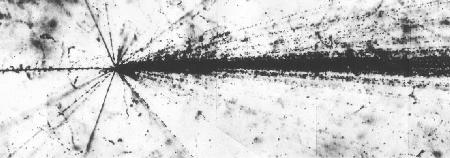
  A collision between a high-energy cosmic ray particle and an atom
  in a photographic emulsion, as viewed through a microscope.

What sort of particles are these? On the ground one rarely encounters the "primary" cosmic rays, because they generally collide high in the atmosphere and all we get below is a shower of very fast fragments. However, sensitive photographic plates have been lifted by balloons to the top of the atmosphere, and have recorded there the passage of "primary" cosmic ray particles. The plates were developed, the tracks were scanned through microscopes, and by the thickness of those tracks, the particles which had caused them were identified. This method showed cosmic ray particles to be ions of a familiar sort--mostly hydrogen, some helium, diminishing amounts of carbon, oxygen etc. and even a few atoms of iron and of heavier elements, to all intents proportions similar to those found on the Sun. The conclusion seems to be that here is ordinary matter, which had undergone some extraordinary process to gain huge energies.

Those energies are indeed huge. The atmosphere shields us from cosmic rays about as effectively as a 13-foot layer of concrete, yet a large proportion of cosmic ray particles manages to send fragments all the way through it. Some have much, much higher energies, though as one goes up in energy, the numbers drop drastically. Cosmic ray ions at the top of the energy range produce in the atmosphere showers of many millions of fragments, covering many acres, and their more energetic fragments register even in deep mines, a mile underground. Relatively few of the particles are so energetic--an experiment might register them once a week--but their existence is a real riddle. How can a single atomic nucleus gain such extreme energies?

Supernovas

To all intents, cosmic rays arrive evenly from all directions in the sky, but this does not necessarily mean their sources are evenly spread around us. More likely, they are constantly deflected and scattered by magnetic fields in the galaxy, until any trace of their original motion is lost. In a similar way, sunlight on a heavily overcast day seems to arrive evenly from the entire sky, and we have no idea where the Sun actually is, because its light is thoroughly diffused by water droplets in the clouds.

Where direct evidence is lacking, one can only guess, using physics and whatever else is known about the universe. The consensus these days is that cosmic ray ions are energized by shock waves which expand from supernovas.

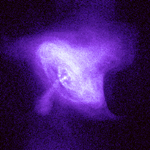
 Supernova in the Crab nebula
 seen in X-rays by the Chandra spacecraft
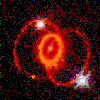
    A supernova is a star which has run out of the "nuclear fuel" of light elements (especially hydrogen), needed to keep it shining. Its "nuclear burning" gradually converts light elements into heavier ones, and the heat it produces keeps the star puffed up, resisting the pull of gravity which would like to draw it together. When the star can no longer produce nuclear heat, it suddenly collapses to a small volume, releasing in the process an enormous amount of gravitational energy. Much of that energy is spent in a grand explosion, blowing the star's outer layers out to space and creating a huge expanding shock front.
By good fortune, such an explosion was observed in 1987 in a nearby galaxy, and its shock wave (inner brightness, picture above) has recently been observed, together with some earlier emissions (large circles) which still puzzle astronomers:

 Remnant of
 Supernova 1987
Note: A much more detailed discussion of the way energy is released in stars and of their final collapse can be found in section (S-7) The Energy of the Sun of "From Stargazers to Starships"; see http://www.phy6.org/stargaze/Sun7enrg.htm.


Cosmic Rays and the Magnetosphere

Where does the magnetosphere enter all this? Neither acceleration by collision-free shocks nor other particle acceleration processes observed or proposed in space can be duplicated in the laboratory. We have no way of reproducing the large distances and low densities of space, and the phenomena cannot be scaled down properly to laboratory dimensions.

In trying to understand the physics of such phenomena, the Earth's space environment is our best laboratory, and satellites are the probes which can provide us with relevant information. For instance, the Earth's bow shock (a relatively mild shock wave) can be studied for varying solar wind speeds and magnetic field angles, and some acceleration processes indeed seem to occur there.

Shock acceleration can also take place inside the magnetosphere (click here for the story of one such event, in March 1991). Yet other acceleration modes exist too, in substorms and auroral beams, and similar processes may also occur in the distant universe and on the Sun. In the long run, the most important reason for studying the magnetosphere might well be that here is our own "cosmic laboratory," replicating the processes which affect the distant universe.

Next Stop: #34.  High Energy Particles in the Universe


#34.     High Energy Particles

Cosmic rays are not the only sign of high energy particles in the distant universe. Additional evidence comes (like most astronomical data) from visible light and other types of electromagnetic waves, e.g. x-rays and radio waves.

Such waves usually arise in one of two ways--by "photon processes" and by processes resembling the broadcasting of radio waves.

Photon Processes

Photon processes are related to the quantum nature of light, discovered only in the 20th century, by which light or any other electromagnetic wave is only created or absorbed in definite "energy packets" called photons. The shorter the wavelength, the more energetic the photon--for instance, since blue light has a shorter wavelength than red light, its photons are more energetic. Certain black-and-white films can be safely handled in photographic darkrooms illuminated by deep red light, because the red photons do not carry enough energy to initiate the chemical changes that darken the film.

Photons of visible light have about 2 electron volts (ev), while medical x-ray photons may have energies of 50,000 ev and those of gamma rays reach 1,000,000 ev and even more. The arrival of (say) 50,000 ev x-ray photons from space is evidence of particles with at least that much energy, often much more, since each photon comes from a single particle. No process exists by which, for instance, ten electrons with 5000 ev each combine their energy to create a single photon of 50,000 ev.

Celestial x-rays cannot be observed from the ground, because the atmosphere quickly absorbs them. They can however reach satellite observatories orbiting above the atmosphere, and several of those have mapped the x-ray sky--the small Uhuru and the larger Einstein observatory, both launched by NASA, and more recently the very successful European ROSAT whose name (Roentgen-satellite) honors the discoverer of x-rays. Some x-ray sources seem associated with strange binary stars and black holes, others still puzzle us, but all suggest a source of high-energy particles.

The X-rays used by the doctor to spot broken bones and impacted teeth are valuable because they penetrate matter, the way light penetrates a windowpane. To produce sharp images of X-ray stars in the sky, on the other hand, X-rays must be focused. It seems like an impossible task, but it isn't--because when X-rays strike a surface at a flat angle, they are reflected, same as light off a mirror. Like a flat stone tossed at the surface of water, they bounce off when they hit at a shallow angle, but go through if the angle is too steep. That too was the design principle of the orbiting Chandra, named for Subramanian Chandrasekhar, an Indian astronomer who became one of the leaders and oustanding teachers of the US astronomy community.

The "Chandra" orbiting X-ray telescope was launched from the Space Shuttle on July 23, 1999, and it focuses X-rays from a series of ring-shaped mirrors. Imagine you cut off the tread of a tire, to produce a ring with a curved cross section. The "Chandra" telescope has metal focusing surfaces shaped like the inside of this ring, and by shallow reflections they bring X-rays to a focus.

Gamma Ray Bursts

Of all the high-energy photons beamed at us by the universe, probably none are more puzzling than those emitted in gamma ray bursts. In the 1960s the US launched a series of spacecraft with accurately timed gamma-ray detectors, to monitor nuclear tests in space and later to enforce the international ban on such tests. The idea was that by having several well-separated satellites note the exact arrival times of the radiation (gamma rays travel at the speed of light) the sources of radiation could be pin-pointed.
    [All that is involved is a trigonometric calculation: the 24-satellite network of the "Global Positioning System" (GPS) uses somewhat similar principles, with the travel time of radio waves from a set of orbiting satellites pin-pointing positions on the ground. These satellites, at distances of 4.1 Earth radii, continually broadcast their precise locations, and these can be read by small portable receivers, relatively inexpensive. Using a built-in computer, these receivers then derive their own precise position on the ground, within 10-50 meters. Russia operates its own system, GLONASS, and European countries are planning a third one. For more details, see here.]

The spacecraft indeed observed brief bursts of gamma rays, but the timing suggested that they came not from Earth but from deep space. Later some fairly accurate "fixes" were obtained for a few events and powerful telescopes were trained on the indicated locations, but they saw nothing remarkable there.

There exists no generally accepted explanation for gamma ray bursts. Some promising theories were abandoned when NASA's Compton Gamma Ray Observatory satellite (CGRO) found in 1991 that they seemed to occur equally in all directions. Had they originated in our own galaxy, they would have probably been concentrated in the direction of the Milky Way, where most of our galaxy's stars are found (the galaxy is a flattened disk, and when we look at the Milky Way we see it edge-on). The new evidence suggests that they could come instead from distant galaxies, and if so, their sources must be incredibly powerful.

    Added note: On March 2, 1997, the Dutch-Italian satellite BeppoSAX ("Beppo" was the nickname of the late Italian physicist Ochialini, after whom the orbiting observatory was named) reported a gamma-ray burst, and turned its x-ray telescope to the region. The X-ray telescope reported a continuing source of X-rays, and NASA's orbiting Hubble telescope (as well as the Keck Observatory on the ground) observed a visible "star" at the appropriate location, probably a distant galaxy. So far no definite conclusions have emerged (see Nature, 17 April 1997, p. 650).

Radio Waves

The other mode resembles the broadcast of radio waves from an antenna. A radio antenna carries a rapidly alternating current which flows back-and-forth along it, and the back-and-forth motion (viewed from the side) of an energetic particle, when it spirals around a magnetic field line, acts the same way. ("Photon laws" apply here too, but because the photons are quite small, the "antenna viewpoint" may be used.)

Radio waves from space were discovered accidentally in 1932 by Karl Jansky, a radio engineer with the Bell Labs. Since then many radio telescopes have scanned the skies and have discovered remarkable sources of radio and microwaves. Often they seem to indicate high-energy particles; for instance, some sources associated with distant galaxies suggest particles trapped in enormous magnetic structures. Some come from the center of our own galaxy, where linked radio telescopes thousands of miles apart have pinpointed an extremely compact source, possibly a giant black hole.

Perhaps the best known sources of this class are pulsars, sources of radio pulses whose repetition rate is extremely regular. They seem to be "neutron stars," collapsed remnants left behind by supernova explosions, stars as massive as the Sun but as dense as the atomic nucleus, no larger than 8-10 miles across. The collapse also greatly amplifies any existing magnetic field and speeds up enormously the star's rotation, creating compact stars which rotate about once a second, sometimes faster, with extraordinary strong magnetic fields.

It is believed that the radio pulses come from particles spiraling in those fields and that they are beamed in directions dictated by magnetic field lines. Thus as the pulsar rotates its radio beam, like the light-beam of a lighthouse, sweeps again and again past the Earth. The pulsing rate has been observed to decrease very slowly, suggesting processes which gradually slow the rotation down.

  The Crab Nebula

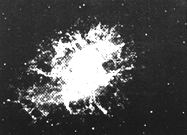
    The most recent supernova in the Earth's part of the galaxy was observed in China in 1054. It left behind it a peculiarly looking glowing cloud, the Crab Nebula, whose central star was recently revealed as a very rapid pulsar, with a radio signal pulsing about 30 times a second; it also pulses in visible light and in x-rays. The light of the nebula itself is polarized (vibrating in a certain ordered way), again suggesting electrons of very high energy spiraling in a magnetic field, and the nebula also contains many bright filaments (picture), which might well be magnetic in origin.

Theorists have speculated that the only way particles can escape the powerful magnetic trap--and radiate signals as they do--would be along the rotation axis, which by necessity is also the magnetic axis. The image on the right, taken of the Crab nebula by the orbiting "Chandra" telescope (see above) seems to fully confirm that view.
Closer to Home

High-energy electrons in the magnetosphere also emit x-rays and radio waves, in their own style. Positive ions, being heavier, tend to move more slowly and to radiate less efficiently.

To produce x-rays or gamma rays, electrons must collide with some more massive target. In a doctor's x-ray machine, for instance, they are shot onto a chunk of metal, inside a vaccum tube (electrons hitting the screen of a TV picture tube also produce x-rays, but these are absorbed by the glass). Out in space collisions are very few, but x-rays are produced when beams of auroral electrons hit the atmosphere.

In 1957 instruments of the University of Minnesota, carried by a balloon to the upper fringes of the atmosphere, detected x-rays emitted by auroral electrons many tens of miles above them. The recent "Polar " satellite carries an x-ray imager, highlighting regions in which auroral electrons are particularly energetic. The pictures produced are much less detailed than the ones in visible and ultra-violet light, from the other auroral imagers on "Polar." These latter images are particularly useful when the satellite is far from Earth, because their images then cover the entire polar cap; but rather detailed x-ray pictures have been obtained from the other end of the orbit, when "Polar" sweeps down, observing the auroral region at close range.

Many different types of radio emissions are generated by ions and electrons trapped in the magnetosphere, but few can be detected from the Earth's surface, because the ionosphere, at 100-300 km above our heads, usually reflects them back into space, just as it reflects back to Earth broadcasts of short-wave radio stations. However, in July 1962 a high-altitude nuclear test by the US created a dense temporary radiation belt of fast electrons, and radio noise from the new belt was then detected on the ground.

Even earlier, in 1955, strange radio signals were found to come from the planet Jupiter, greatly puzzling radio astronomers. The source turned out to be the planet's immense radiation belt. The fact that some of the emissions were found to be controlled by the position of the satellite Io is probably related to the electrical currents linking Io to Jupiter. The space probes which have visited Jupiter--Pioneers 10 and 11, Voyagers 1 and 2, Ulysses and most recently Galileo--have observed at close hand many types of radio waves, beamed in interesting modes which still defy explanation. The first four went on to Saturn, and Voyager 2 continued to Uranus and Neptune, all of which were found to be magnetized, have radiation belts and emit radio waves. The solar system thus has magnetosphere beyond the Earths, waiting to be explored, differing from ours by the presence of moons and rings and by other features.

Satellites orbiting outside the Earth's ionosphere record a veritable "zoo" of radio emissions, not all of them understood. Most intense is the "auroral kilometric radiation" originating above the aurora ("kilometric" is the order of magnitude of its wavelength, below the AM radio band). The "antenna processes" by which these waves originate are profoundly affected by the surrounding plasma and by the way it interacts with the magnetic field. Such waves therefore provide valuable information about magnetospheric plasmas.

Next Stop: #35.  Solar Energetic Particles


#35.     Solar Energetic Particles

We cannot observe the way the distant universe accelerates cosmic rays or produces energetic photons, but acceleration processes also occur on our Sun, though on a much more moderate scale.

Starting in 1942, Geiger counters and other detectors, set up to monitor cosmic rays, have occasionally seen sudden increases in the intensity of the radiation, associated with outbursts on the Sun, mostly with visible flares. The cosmic ray intensity returns to normal within minutes or hours, as the acceleration process ends and as accelerated ions disperse throughout interplanetary space.

On the scale of cosmic radiation, solar-produced ions have relatively low energies, generally below 1 Gev (=billion electron volts) and rarely above 10 Gev. That is why such events are often missed by cosmic ray detectors near the equator, where the lowest energies are excluded by the Earth's magnetic field. The best detectors for observing solar particles are therefore those sensitive to the lowest energies of the cosmic radiation.

In many events the Sun emits enormous numbers of lower-energy ions, with no more than tens of Mev (=millions electron volts). The Earth's magnetic field diverts them to the vicinity of the magnetic poles, where they may temporarily smother the ionosphere and interfere with radio communications. Such "polar cap blackouts" used to bother US military radar installations which scanned the polar cap for hostile missiles.

A GOES Satellite
    Electrons are also accelerated by solar events, though to lower energies. Since electrons are much lighter than positive ions, they are more tightly held by the Sun's magnetic field lines. They are also more likely to lose energy in the form of radio waves, x-rays and gamma rays (the same as magnetospheric electrons). Thus they often do not escape, but their presence is indicated by other emissions, e.g. the bright x-rays seen by Yohkoh. Solar acceleration events are often accompanied by bursts of x-rays, sometimes reaching their peak intensity within seconds and thus suggesting an equally abrupt acceleration process. The GOES monitoring satellites of US National Oceanic and Atmospheric Administration (NOAA), observing the weather from synchronous orbit, also keep tabs on the Sun's activity by means of sensitive x-ray detectors.


Where and How?

Oh, how do solar astrophysicists wish they knew where and how do these solar particles get their energy! The general consensus is, however, that the energy of accelerated solar ions and electrons is derived from the magnetic fields that rise above sunspots. It is not just that magnetic fields are generally associated with particle acceleration, but also, no other available source could release energy so quickly.

While searching for an explanation of particle acceleration on the Sun, British researchers in the 1950s, in particular Peter Sweet and James Dungey, proposed the idea of magnetic reconnection, an idea later applied to the Earth's magnetosphere and to substorms. Reconnection is still believed to be the energy source of flares and CMEs, but unfortunately, it seems to happen in the lower corona, where magnetic structures are invisible (with a few exceptions--see picture below). The nature of substorms and solar acceleration events may indeed be similar, though their scales differ greatly. However, satellites can be sent to substorms but not to the Sun, and therefore magnetospheric research may well hold clues to some of the problems of solar physics.

Theorists have proposed that reconnection and acceleration on the Sun occur near the tops of magnetic "arches," of field lines rising from sunspot regions, like the one pictured above. When the Solar Maximum Mission in 1981 spotted on the Sun's surface two bright pin-point sources of x-rays, appearing at the beginning of an acceleration event, it was widely assumed that they marked the impact of beams of electrons accelerated at the top of an "arch" and guided by its field lines down to the Sun. More recently, the Japanese x-ray imager aboard the Yohkoh satellite has observed a bright x-ray source formed at the top of an arch (picture on right), lending further support to the theory.

Flare seen in X-rays by Yohkoh.

  • Note added May 1997. The solar observatory SOHO, located near the L1 Lagrangian point, has provided additional evidence for reconnection at the Sun, by observing bi-directional jets of fast-flowing plasma. Quoting from an article by D.E. Innes et al (Nature, 24 April 1997, p. 811; see also p. 760): "...we report ultraviolet observations of explosive events in the solar chromosphere that reveal the existence of bi-directional plasma jets from small sites above the solar surface. The structure of these jets evolves in the manner predicted by theoretical models of magnetic reconnection, thereby lending strong support to the view that reconnection is the fundamental process for accelerating plasma on the Sun."

Should we Worry?

Should we be concerned about solar energetic radiation? On Earth we are safe, protected by the thick layer of our atmosphere, equivalent to 10 meters (32 feet) of water or about 4 meters of concrete. Astronauts on a space station orbiting near the Earth's equator are protected by the Earth's magnetic field. However, astronauts on their way (say) to Mars, separated from space by just a thin metal shell, are quite vulnerable. Luckily, life threatening radiation events are rare, especially during low years of the sunspot cycle. Still, as the large particle events of August 1972 have shown, some danger remains even then.


Authors and Curators:

Last updated 24 February 2000