Center of Gravity
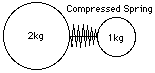
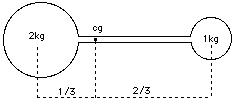
Most people have at least an intuitive notion of the center of gravity (CG) of an object: it is the point on which the object can be perfectly balanced. Grab a broom at one end and the other end tries to drop down; grab it at its center of gravity, and it stays balanced, neither end tipping over. If you have learned to balance a chair or a broom on the palm of your hand, you know the trick is to place your hand right below the center of gravity. Since your hand is not at the CG but below it, it must be constantly moved to keep that strategic position. There also exists a precise mathematical definition--it has nothing to do with gravity, which is why many scientists and engineers prefer the term center of mass. However, it leads off the main subject and therefore we won't bother with it now. A lightweight stick with two balls of equal weight at its end obviously has its CG in the middle. When one ball is twice the weight of the other, the CG divides the distance between them by a ratio 1:2, in a way that makes it closer to the heavier mass (see figure). And similarly for other ratios. Balls that push each other
Now imagine that instead of a lightweight stick the above two heavy balls have a spring between them, held compressed by a string. Even though the balls are separate, one can speak of their common center of gravity, on the line connecting their centers, 1/3 of the distance from the center of the heavier ball. (The CG of the Earth-Moon system can be defined in the same manner. Since the ratio of masses of the two bodies is about 81:1, the CG is the point on the line between their centers dividing it by that ratio. It can be shown that--neglecting the pulls of the Sun and of other planets--the Moon does not orbit the center of Earth, but rather the common CG--and so does the Earth, reacting to the pull of the moon. Of course, since the Earth is much more massive, the CG is not very far from the center of the Earth--in fact, it is closer than the Earth's own surface.) Suppose next that a lit match is placed against the string, burning it through. As the spring expands, it pushes the balls apart; if it is sufficiently light, its own motion does not matter and we can assume that the balls push each other. By Mach's formulation of the equations of motion, if the heavy ball receives an acceleration a, then the light one gets 2a, twice as much. For each increment in the velocity of the heavy ball, the light one receives twice as much, and it follows that at any time, its total velocity, as well as the distance covered, are twice those of the heavy ball. If then the heavy ball is at a distance D from the initial position of the spring, the light one is at distance 2D--as in the earlier figure, reproduced here. No matter how much time passes, the center of gravity stays at the same spot. RocketsThat turns out to be a very general principle: in any object or collection of objects, forces which only involve those objects and nothing else ("internal forces") cannot shift the center of gravity. An astronaut floating in a space suit cannot shift his position without involving something else, e. g. pushing against his spacecraft. The center of gravity--or "center of mass"--is a fixed point, which cannot be moved without outside help (turning around it, however, is possible). By throwing a heavy tool in one direction, the astronaut could get moving in the opposite direction, though the common center of gravity of the two would always stay the same. Given a bottle of compressed oxygen, the same result follows from squirting out a blast of gas (a scene that appeared in an early science fiction film). A rocket does much the same, except that the cold gas is replaced by the much faster jet of glowing gas produced by the burning of suitable fuel.
The powerful rockets which lift hundreds or even thousands of tons off the launching pad depend on the same principle. If you ever watched a rocket lift off at Cape Canaveral, it is worth remembering that if you could somehow remove from the scene the launching pad, the atmosphere and the Earth, then the combined center of gravity of the rocket and its exhaust gases would always remain where it started, at the launching point. It may seem like a round-about way for producing motion. And yet, rockets are (at least for now) the only practical means of leaving Earth and flying into space. |
Next Stop: #26 Robert Goddard and his Rockets
#################################
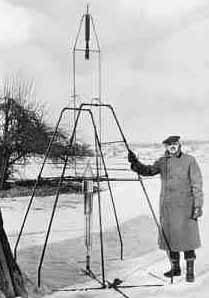
Early RocketsRockets were invented by the Chinese, a spin-off from their invention of gunpowder--some time around the year 1000, perhaps earlier. Rockets added a new dimension to fireworks--another Chinese contribution--but, invevitably, they were also applied to warfare, as missiles to set the enemy's cities on fire. The British took notice in 1791, when Indian troops, under Tipoo Sultan, employed rockets against them. William Congreve, a British officer, developed a military rocket and in 1806 urged its use against Napoleon. "The rocket's red glare" in the US anthem refers to the use of Congreve rockets in 1814 in an unsuccessful British attack on Fort McHenry, outside Baltimore. The aim of such rockets was notoriously inaccurate, and their use declined as artillery improved. However, commercial rockets were sold for use by ships, for carrying a line to the shore in case of shipwreck. Still, rockets were the only credible way of reaching distant space. One visionary who realized this was Konstantin Tsiolkovsky (1857-1935), a Russian teacher who enthusiastically promoted spaceflight and wrote books on the subject, long before the idea received serious consideration. GoddardAnother was a young American, Robert Hutchins Goddard (1882-1945). A native of Worcester, Massachusetts, Goddard's family was staying at the suburban home of friends in Worcester when, on October 19, 1899, he climbed into an old cherry tree to prune its dead branches. Instead, he began daydreaming:
That was when young Goddard decided to pursue the idea of spaceflight. He later wrote
(Anniversary Day)
The patent application was for US patent #1,103,503, granted in July 1914 together with an earlier one, #1,102,653. "Plurality" was Goddard's term for multiple rocket stages, and the patents also covered expansion nozzles and liquid fuel, although Goddard did not experiment with them until 1915 and 1922, respectively.
In 1915, as assistant professor at Clark University, Worcester, he began experiments on the efficiency of rockets. He bought some commercial rockets and measured their thrust using a ballistic pendulum, a heavy mass suspended by ropes, to which the rocket was attached. The rocket was fired, and the height to which the pendulum rose provided a measure of the total momentum (mass times velocity) imparted to it. It can be shown from Newton's laws that the total momentum of a system free from outside forces is conserved; that is actually another formulation of the conservation of the center of gravity, mentioned in the discussion of rocket propulsion. Therefore the momentum given to the pendulum in one direction had to be equal to the momentum mv imparted to the rocket's gas jet and that momentum determined the length and height of its swing. By weighing the rocket before and after firing, Goddard could derive the mass m of the ejected gases and from that deduce v. For a 1-pound Coston ship rocket, he found that v was about 1000 ft/sec (300 m/sec). A rocket is essentially a heat engine, a device for converting the energy of heat (obtained from the chemical energy of the fuel) into mechanical energy--here the kinetic energy mv2/2 of its exhaust jet. Knowing m and v, Goddard could derive the kinetic energy given to the gas, and by burning a measured amount of the fuel, absorbing the heat (e. g. in water) and measuring the rise in temperature, the total amount of chemical energy converted to heat could also be obtained. The conclusion was rather disappointing: only about 2% of the available energy contributed to the speed of the jet. Could this be improved? Luckily for Goddard, this problem had been solved by Gustav De Laval, a Swedish engineer of French descent. In trying to develop a more efficient steam engine, De Laval designed a turbine whose wheel was turned by jets of steam.
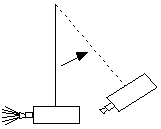
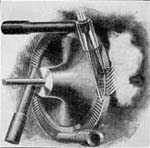
The critical component, the one in which heat energy of the hot high-pressure steam from the boiler was converted into kinetic energy, was the nozzle from which the jet blew onto the wheel. De Laval found that the most efficient conversion occured when the nozzle first narrowed, increasing the speed of the jet to the speed of sound, and then expanded again. Above the speed of sound (but not below it! ) this expansion caused a further increase in the speed of the jet and led to a very efficient conversion of heat energy to motion. Nowadays steam turbines are the preferred power source of electric power stations and large ships, although they usually have a different design--to make best use of the fast steam jet, De Laval's turbine had to run at an impractically high speed. But for rockets the De Laval nozzle was just what was needed. Goddard experimented on his ballistic pendulum with various nozzle designs, using a small metal combustion chamber filled with a type of gunpowder, ignited by electricity. The end of the chamber was threaded, so that nozzles of various designs could be screwed onto it and tested. Using a De Laval nozzle, he obtained jet velocities between 7000 and 8000 ft/sec and efficiencies of up to 63%. Later he replaced the ballistic pendulum with a more compact device, in which the thrust of the rockets did not lift a pendulum against gravity but compressed a calibrated spring. With that device he showed that (contrary to some popular claims) rockets worked just as well in a vacuum. As Goddard himself noted, that made the rocket the most efficient of all heat engines, better than piston-driven steam engines (21%) and Diesel engines (40%). No wonder: from the second law of thermodynamics, the theoretically attainable efficiency of a heat engine increases with its operating temperature, and no other heat engine runs as hot as a rocket.
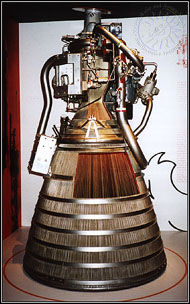
After the US entered World War I, Goddard also worked for a while on military rockets, but none of his designs were implemented, though rockets somewhat similar to his design were turned in World War II into an effective weapon against tanks, known as the bazooka.
On March 16, 1926, Goddard flight-tested his first liquid-fuel rocket. He thought stable flight could be obtained by mounting the rocket ahead of the fuel tank, with the tank shielded from the flame by a metal cone and the lines for fuel and oxygen pulling it behind the rocket: the design worked, but did not produce the hoped-for stability. The rocket burned about 20 seconds before reaching sufficient thrust (or sufficiently lightening the fuel tank) for taking off. During that time it melted part of the nozzle, while the camera with which Mrs. Esther Goddard was trying to record the flight ran out of film, so that no photographic record of that flight remains. Then it took off to a height of 41 feet, leveled off and later hit the ground, all within 2. 5 seconds, averaging about 60 mph. Goddard's concept seemed validated, but he was still far from a practical design. Unfortunately, he worked in isolation, without the engineering resources of a major institution. In the years that followed he continued developing his rockets--controlling their motion by gyroscopes, steering them with small vanes thrust into their exhaust jet, and building larger and faster rockets. These were tested in test stands on the ground and sometimes also in free flight, mostly at a rocket lab he established in Roswell, New Mexico. But the actual realization of his dream fell to others who enjoyed military or national support. Goddard, unfortunately, never lived to see the age of spaceflight. He died of cancer on August 10, 1945, in Baltimore. |
Next Stop: #27 The Evolution of the Rocket
#################################
GermanyThe full story of rocket technology is too long to be covered here. Between World Wars I and II, especially in the 1930s, rocket enthusiasts and rocket clubs were active in Germany, the US, Russia and other countries. Experimental rockets were designed, tested and sometimes flown. Some of the experiments used liquid fuel, though solid-fuel rockets were also developed. In the latter, the fuel gradually burned off (as it did in early gunpowder rockets), and the entire fuel container was under pressure, supplying hot gas directly to the De-Laval nozzle.
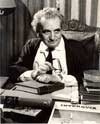
The hotbed of rocketry was Germany, where Hermann Oberth, a transplanted Romanian, vigorously promoted the idea of spaceflight, even though his doctoral thesis "The Rocket into Interplanetary Space" was rejected by the university of Heidelberg. Oberth was an early member of the "Society for Space Travel" (Verein fuer Raumschiffahrt or VfR) formed in 1927. In 1930 the VfR successfully tested a liquid fuel engine with a conical nozzle which developed a thrust of 70 newtons (about 10 newtons will lift 1 kg). By 1932 it was flying rockets with 600-newton motors. The V2 RocketBy that time, however, the German army had begun developing rockets for its own use, and in 1932 it enlisted the help of a young engineer named Wernher Von Braun. The military's rockets were larger and more ambitious, and the A2 which flew in 1934 developed a thrust of 16000 newton. This line ultimately led to the A4, designed and tested under Von Braun's supervision, a 12-ton rocket with a thrust of 250 000 newtons, a 1-ton payload and a range of 300 km (about 200 miles).
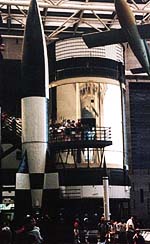
Renamed the V-2 ("vengeance weapon 2") by the German army, hundreds of rockets of this type were fired in late 1944 towards London, a target large enough to ensure serious damage even without precise guidance. Because these missiles flew much higher and much faster than any airplane, Britain had no way of intercepting them, and bombing their launch sites was also difficult, since the V-2 (like Iraq's missiles in 1991) employed mobile launchers. The attack only stopped when the German army was pushed beyond the rocket's range. Today a V-2 is on display at the National Air and Space Museum of the Smithsonian Institution in Washington (picture on the right). In the USA
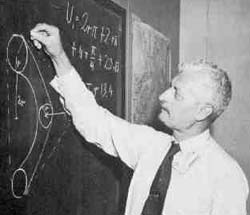
Meanwhile rocketry was developing in the US, quite apart from Robert Goddard's efforts. One noted pioneer was Theodore Von Karmán, a native of Hungary and the graduate of the Minta, one of the famed high schools of Budapest from which came a remarkable number of distinguished scientists. Karmán became an authority on aerodynamics and in the 1930s served as professor of aeronautics at Caltech, the California Institute of Technology in Pasadena, California. Together with Frank Malina, one of his graduate students, Karmán began designing and building rockets at Caltech's Guggenheim Aeronautical Lab (supported by the Guggenheim family which also financed Goddard's work). Because rockets had a dubious "far out" connotation, they referred to their work as "jet propulsion. " Ultimately Karmán and Malina established at Caltech a laboratory devoted to rocket work, the Jet Propulsion Laboratory (JPL); today JPL is virtually part of NASA, a large lab specializing in the exploration of the solar system beyond Earth. Another distinguished student of Karmán was Hsue Shen Tsien, who later returned to China and helped establish that country's spaceflight effort. Karmán's group built both solid-fuel and liquid-fuel rockets. During World War II one of the problems was getting heavily loaded seaplanes into the air, Karmán and his engineers solved this by designing the JATO rocket, for "Jet Assisted Take Off." It originally burned a mixture of roofing tar and perchlorate, an oxygen-rich compound similar to the one used by chemistry teachers for producing oxygen in classroom demonstrations: the tar was the fuel and the perchlorate provided the oxygen. (Robert Goddard designed an alternate liquid-fuel JATO rocket, but it was not successful. ) Later they designed the solid-fuel "Private" for military use, and a bigger liquid-fuel rocket, the "Corporal. " The latter was adapted for high-altitude research as the "WAC Corporal" (WAC stood for Women's Auxiliary Corps) which, with a thrust of 6700 newtons, reached in 1945 a height of 70 km; later a larger scientific rocket was developed from it, the Aerobee. Military UsesApart from the V-2, the various armies in WW II used solid-fuel artillery rockets much in the way that Congreve had used them, for massive bombardments, to cover attacks or beach landings; the Russian army, for instance, had its famed "Katyusha".
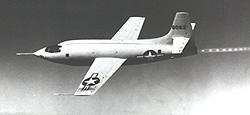
In addition Germany developed rocket-powered fighter planes, whose engines only burned long enough to enable them rise and intercept American bombers, after which they glided to Earth, to land without any engine. These, however, were weapons of desparation, and the war ended before they could be used. After the war, in 1947, the US built and flew a rocket airplane, the X-1, and it became the first airplane to exceed the speed of sound in level flight, on 14 October 1947. The X-1, too, can be seen in the Smithsonian museum. Rocket Staging and TechnologyEach of the above rockets had a single engine, on which it rose until it ran out of fuel. A better way to achieve great speed, however, is to place a small rocket on top of a big one and fire it after the first has burned out. Suppose one wanted to use a V-2 rocket to send a small payload--e.g., 10 kilograms--as high as possible. The usual payload of the V-2 rocket was one ton (1000 kg), and with that a height of about 100 km was possible. Reducing the payload to 10 kg would increase that height somewhat, but not by much, since the empty rocket, weighing about 3 tons, would also have to be raised to the full height.
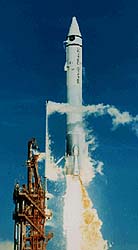
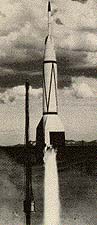
The US army, which after the war used captured V-2s for experimental flights into the high atmosphere, used a more effective way. It replaced the payload with another rocket, in this case a "WAC Corporal," which was launched from the top of the orbit. Now the burned-out V-2, weighing 3 tons, could be dropped, and using the smaller rocket, the payload reached a much higher altitude. Such was the "Bumper" rocket (on the right) which in February 1949 reached an altitude of 393 km. Today of course almost every space rocket uses several stages, dropping each empty burned-out stage and continuing with a smaller and lighter booster. Explorer 1, the first artificial satellite of the US which was launched in January 1958, used a 4-stage rocket. Even the space shuttle uses two large solid-fuel boosters which are dropped after they burn out (the "Challenger" disaster in 1986 occured when one of them failed). The fuel for the shuttle's own engines--liquid hydrogen and oxygen--comes from a huge detachable tank. As that fuel is used up, the boosted mass decreases, and by Newton's 2nd law, the acceleration increases steadily (it is hard to reduce the engine's thrust, though the shuttle can do so to a limited degree). To reduce the acceleration and save the astronauts and the vehicle from excessive stress, at a chosen point in the flight two of the three engines are shut off. Even then, when the last fuel in the tank is burned, the acceleration reaches about 6g, pressing each astronaut down with an added force 6 times his or her body weight. Persons not familiar with spaceflight rarely realize that almost all of a rocket's launch mass consists of fuel. The launch mass of the V-2 was about 75% fuel and 25% rocket, but as high as that may seem, it is not nearly good enough for spaceflight. In a 1948 article in the American Journal of Physics, titled "Can We Fly to the Moon? " the authors answered their question with a resounding "no! " They extrapolated the V-2 technology to larger rockets, estimated that 80% of the weight would be fuel, and concluded that a payload of 10 kg might be sent to the moon, but never a human being. The Atlas Rocket
Flights to the moon were only made possible by a technology in which the fuel formed a much bigger fraction of the mass. Of the mass of the Atlas missile, built in the 1950s and used by the first astronauts, about 97% was fuel. That rocket has been described as a "stainless steel balloon," keeping its shape with the help of pressurized gas in its interior, also used in pushing out the fuel. That was the vehicle with which on February 20, 1962 John Glenn became the first American to orbit the Earth. Because the fuel tank was so light, the Atlas only dropped two of its rocket engines at the end of the first stage of its flight, and like the shuttle continued on a third. |
Site on Hermann Oberth
On the life of Wernher Von Braun--links to several sites
Von Karmán was only one of many distinguished alumni of the high schools of Budapest, capital of Hungary, around the turn of the century. More names and details can be found in "The Hungarian Phenomenon" by Arthur O. Stinner, in The Physics Teacher, p. 518-22, vol 35, December 1997. Incidentally, much of the impetus behind those schools came from Lorand Eötvös, (link) noted earlier in connection with the concept of mass, and from his father Joszef.
Site on the history of rocketry.
"Can we fly to the Moon?" by Joseph Himpan and Rudolf Reichel, American Journal of Physics 17,251-262, 1948.
Article "The Karmán years at GALCIT", Ann. Rev. Fluid Mechanics, 11, p. 1-10, 1979.
Next Stop: #28 Spaceflight
#################################
A book on Yuri Gagarin: "Starman: The Truth Behind the Legend of Yuri Gagarin" by Jean Doran and Piers Bizony, Bloomsbury (Great Britain) 1998.
Next Stop after the ones cited above: #30 Far-out Pathways to Space: Great Guns?
#################################
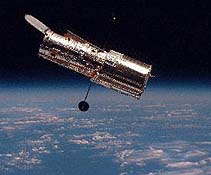
The Earth's atmosphere, while transparent to visible light, absorbs most "electromagnetic radiations" which belong to the same family as light: parts of the infra-red (IR) and all of the ultra-violet (UV), X-rays and gamma rays. And even in visible light, atmospheric fluctuations (similar to the ones that cause stars to twinkle in the summertime) blur telescope images taken at high magnification. The Hubble telescope, in low Earth orbit, overcomes such limitations, in the visible range and in part of the UV. In a celebrated recent time exposure, Hubble remained locked on the same patch of the northern sky for 10 days, returning a sharp image of objects much too faint to be seen otherwise, most of them very distant galaxies. So fruitful was this observation that a second "deep field" exposure of such length, near the southern pole of the heavens, was recently conducted. It yielded a comparably rich array of distant objects. NASA now plans a "next generation space telescope" (NGST) to be placed at the Lagrangian L2 point. In the UV Hubble was preceded by the US-Dutch "International UV Explorer" (IUV), a telescope in synchronous orbit used remotely by astronomers around the globe, like a ground-based observatory. The Infra-Red Astronomy Satellite (IRAS) observed the sky in infra-red and was particularly impressive in its study of the "cosmic background" radiation, left from the "big bang" in which the universe (apparently) began. IRAS was cooled by a well-insulated container of liquid helium, which last months. Several X-ray observatories have surveyed and studied X-ray sources in the sky, most recently the European "Rosat" (Roentgen Satellite) named for the man who discovered X-rays one century before its launch. A large Advanced X-Ray Astrophysics Facility (AXAF) has been renamed Chandra, the nickname of the late distinguished astronomer Subrahmanyan Chandrasekhar. It is due to be launched by NASA in May 1999, the original January launch delayed by a circuit board overhaul. Another European observatory, Beppo SAX (named after the physicist Giuseppe "Beppo" Ochialini) has helped pin-point the first visible source of X-ray and gamma ray bursts. The Compton Gamma Ray Observatory observed the start of that event and also provided evidence showing that the sources of these bursts are very distant and they therefore should represent incredibly large and sudden energy-release events in the early universe. Some satellites specialize in observing the Sun, such as the Japanese Yohkoh and NASA's SOHO. Yohkoh obtained striking images of the Sun in X-rays, while SOHO observes subtle oscillations of the entire Sun, "sunquakes" which tell about the Sun's unseen interior. It also observed "coronal mass ejections" headed for Earth, eruptions whose arrival a few days later may bring a magnetic storm. |
Next Satellite Class: #29b Those observing the Earth
Next Regular Stop: #30 Far-out Pathways to Space: Great Guns?
#################################
|
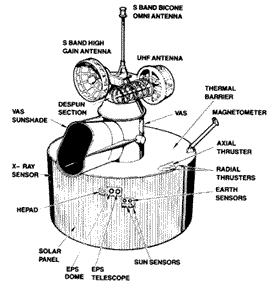
These include satellites which monitor the weather, such as the GOES series (one of which is shown on the right) of the US National Oceanic and Atmospheric Administration (NOAA). They are in synchronous orbit, keeping the same area in view as the Earth rotates. To this class also belong "spy satellites" which observe the ground from low circular orbits. For obvious reasons they are rarely described in public, but some are said to have sizes comparable to that of the Hubble telescope. The US Air Force furthermore sponsors polar satellites of the DMSP series, scanning the globe for rocket launches. |
|
Other satellites scan the Earth for a variety of purposes: for instance, the French SPOT series of surveillance satellites mainly serves commercial customers (one SPOT observed among other things the Soviet nuclear reactor accident in Chernobyl). NASA's Polar collects images of the polar aurora (as did the Swedish "Viking" and "Freja", and several earlier satellites), and the US Landsat series was primarily meant to observe vegetation. The Canadian satellite Alouette in 1962 bounced radio signals off the top of the ionosphere, and UARS (Upper Atmosphere Research Satellite) is currently studying the Earth atmosphere. A large collection of Earth-observing missions, the EOS missions, is being prepared by NASA. |
Next Satellite Class: #29c Those observing local conditions
Next Regular Stop: #30 Far-out Pathways to Space: Great Guns?
#################################
|
Satellites which study their local environment usually do so for some scientific purpose.
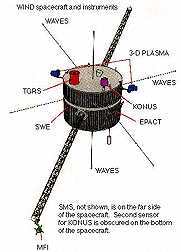
Some of these move in circular orbits, relatively close to Earth--for instance, FAST which analyzes the intricate structure of electric currents, particles and fields in the curtains of the polar aurora, and MAGSAT which in 1979-80 orbited just above the atmosphere and mapped the Earth magnetic field with great precision. A follow-up magnetic survey is scheduled to start in 1999 with the launch of the Danish "Oersted" satellite. Many "down-looking" satellites also carry out local observations, among them Polar, Viking, Freja and satellites of the GOES and DMSP series. Perhaps the most interesting satellites in this group are the ones sent into distant orbits, some of them extending well past the Moon--e.g. the WIND spacecraft pictured here. Among them is a long series of IMPs (Interplanetary Monitoring Platforms) which sampled the Earth's distant magnetic environment, the magnetosphere, and the surrounding interplanetary region; IMP-8 is still returning good data, more than 20 years after its launch. Other explorers of the distant magnetosphere have included the three ISEE spacecraft (International Sun-Earth Explorers), the European HEOS 1 and 2, Russia's Prognoz series and Interball, and Japan's Akebono, Jikiken and Geotail. |
Much more about the observations and discoveries of the satellites mentioned here can be found in the extensive overview, "The Exploration of the Earth's Magnetosphere. "
A listing of NASA's "Explorer" series of satellites can be found here
Next Satellite Class: #29d Satellites for Commercial Benefits
Next Regular Stop: #30 Far-out Pathways to Space: Great Guns?
#################################
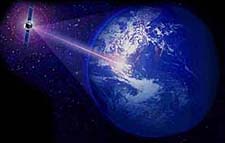
This groups includes about 200 communication satellites ("comsats") scattered in synchronous orbits above the Earth's equator. At a distance of 6. 6 Earth radii (42,000 km or 26,000 miles), these satellite make one orbit per day, and therefore as the Earth turns, they always stay above the same ground station. Comsats have become essential to the relaying of television broadcasts, long distance telephone connections and computer communications: if you are receiving this from the world-wide web (especially if you are outside the US) this document might well have been routed to you through one of them. |
|
NASA maintains several communication satellites as data links to other satellites, an arrangement found more economical than the use of tracking stations on the ground. In addition, networks of low-altitude communication satellites (e.g. "Iridium", a system of 66 spacecraft, plus spares) are being deployed for use by cellular telephones. Some beneficial satellites were already listed under different classifications: weather satellites, like those of the GOES series, and those which scan the Sun and the "solar wind" for activity affecting "space weather" inside the magnetosphere. Still another application is the 24-satellite network of the "Global Positioning System" (GPS), in circular orbits at distances of about 4.1 Earth radii (26,000 km or 16,000 miles). GPS satellites continually broadcast their precise locations, and these can be read by small portable receivers, relatively inexpensive. Using a built-in computer, these receivers then derive their own precise position on the ground, within 10-50 meters. Russia operates its own system, GLONASS, and European countries are planning a third one. Originally developed by the US Department of Defense (whose users derive from them even more precise positions), the GPS satellites are widely used by the public--by ships at sea, airplanes, hikers in the wilderness, even drivers trying to navigate large cities. |
Next Satellite Class: #29e Missions to Planets and to Distant Space
Next Regular Stop: #30 Far-out Pathways to Space: Great Guns?
#################################
|
Finally, the deep space explorers--spacecraft which break away from the Earth's gravity
Quite a few have visited the Moon or orbited around it, most recently "Clementine" and "Lunar Prospector". Some of these--both of the US and the USSR--mapped the moon or landed on it, as preparation for manned landings. The "Luna" series of the USSR conducted 7 soft landing of unmanned probes, two of them with wheeled robotic "Lunokhods," and two of those missions returned samples to Earth. Others spacecraft have visited the major planets of the Solar system. Voyagers 1-2, Pioneers 10-11, Galileo and Ulysses have flown past the giant planet Jupiter: the first four have also visited Saturn, and Voyager 2 continued and visited Uranus and Neptune. Currently the Cassini mission is on its way to Saturn. The Mariner series have explored Venus and Mars--and Mariner 10 even reached Mercury, for three separate encounters! The European pair of Helios spacecraft ventured inside the Mercury orbit, coming closer to the Sun that any other spacecraft--so far: NASA has plans for a "solar probe", to approach within 4 solar radii--only 2% of the Earth's distance, so close that a special shield would be needed to keep it from melting. Incidentally, it would be at that time the fastest moving object in the solar system, moving at 300 km/sec, 10 times faster than the Earth in its orbit.
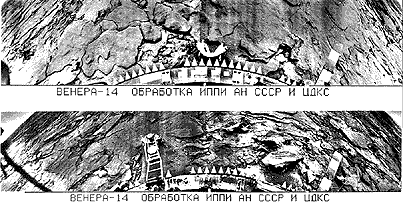
Venus has received particular attention, from NASA's "Pioneer Venus" and most recently "Magellan", which mapped it by radar; two French balloons were successfully deployed by the Russian "Galley" ("Halley"--no H in Russian) on its way to meet comet Halley, and sent back data about the Venusian atmosphere. The Soviet Union has landed several instrumented modules on the planet's surface (a hellish place of high pressure and temperature) and has returned photographs from there (above).
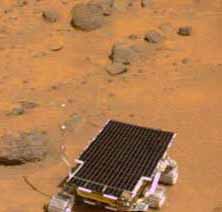
Mars has received considerable attention too, including two US landers of project "Viking" and the current Mars Global Surveyor. Not long ago, "Mars Pathfinder" landed a small robotic vehicle Sojourner on Mars, controlled from Earth (on right). Ulysses flew by Jupiter and used the planet's gravity to deflect its motion to an orbit steeply inclined to the ecliptic, passing above the Sun's poles; this region of interplanetary space had not been explored before and has quite different properties than the one around Earth. Voyager 2 acquired sufficient velocity to escape the Sun's gravity, and among all spacecraft it is currently the one most distant from the Sun. According to theory, some time in the 21st century it will probably pass the limit of the solar wind. If its nuclear power sources hold out until then, it may even tell us about the interstellar space that lies beyond. |
The planetary exploration home page of the Jet Propulsion Laboratory (JPL) contains many links to JPL missions.
A chronology of the exploration of distant space, with many links to mission home pages. (This site has a number of alternative mirror sites.)
The home page of the planetary sciences section of the National Space Science Data Center (NSSDC) contains many further links., including "Planetary Pages".
About magnetospheres of planets other than Earth, click here.
Next Regular Stop: #30 Far-out Pathways to Space: Great Guns?
Author and curator: David P. Stern, u5dps@lepvax.gsfc.nasa.gov
This joined file was created 8 June 2001